
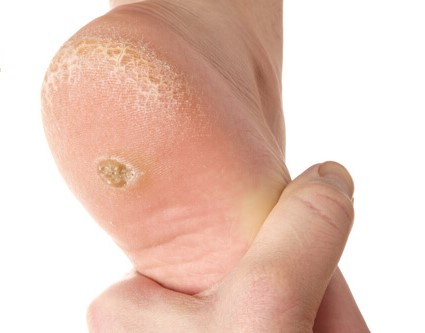
What is a foot corn and why does it form?
A corn is a localised area of thickened skin that develops in response to repeated pressure or friction on a specific point — typically over a bony prominence. The skin's protective response to that repeated pressure is to produce more keratin at the point of contact, creating the hard, cone-shaped core characteristic of a corn.
Common causes:
- Ill-fitting footwear — too tight, too narrow, or with hard seams that press on specific toe joints
- Abnormal foot structure — prominent bony points that create pressure even in well-fitted shoes
- Walking or standing for prolonged periods on hard surfaces
- Not wearing socks, or wearing socks that bunch and create friction points
Hard corns appear most commonly on the tops of smaller toes and the outer side of the little toe. Soft corns form between toes where moisture is trapped. Both become painful when the hard core presses on the nerve tissue beneath.
For patients with diabetes or poor peripheral circulation, even a small corn can progress to an ulcer or infection if left untreated — early professional evaluation is particularly important in these cases.
When home remedies are not enough
Pumice stones, corn plasters, and wider shoes reduce the pressure that drives corn formation — they do not remove the existing corn or address the bony prominence beneath it. For small, early-stage corns in patients without underlying structural issues, these measures can provide relief. For corns that have been present for months, that return repeatedly after self-treatment, or that cause significant pain with walking — professional removal is the appropriate next step.
Over-the-counter corn removal acids (salicylic acid plasters) are effective for superficial corns but carry a real risk of chemical burns to surrounding healthy skin, particularly in patients with reduced sensation or circulation. They should not be used by diabetic patients without medical guidance.
Professional corn removal at Skinssence — what the procedure involves
At Skinssence Laser & Skincare Clinic, corn removal is performed under sterile conditions with local anaesthesia. The procedure typically involves:
- Clinical assessment: Examination of the corn, surrounding tissue, and identification of the underlying pressure point or bony prominence causing recurrence.
- Local anaesthesia: The treatment area is numbed — the procedure itself is not painful.
- Corn removal: Precise removal of the corn including the central core, with careful protection of surrounding healthy skin.
- Underlying cause addressed: Where a bony prominence is the primary driver, this is addressed to reduce the likelihood of the corn reforming at the same site.
- Post-procedure dressing and guidance: Wound covered; footwear and aftercare instructions provided before discharge.
No hospital admission is required. Most patients walk out of the clinic after the procedure.
Recovery and aftercare
- Keep the treated area clean — gently wash with mild soap and water, pat dry
- Avoid prolonged standing or pressure on the area for the first few days
- Wear shoes with good cushioning and a wide toe box — avoid tight footwear that recreates the original pressure point
- Use protective padding over the area as advised — silicone toe sleeves or moleskin reduce friction during healing
- Keep the skin moisturised to prevent dryness and cracking at the treated site
- Contact the clinic if you notice redness, increased warmth, swelling, or discharge — early signs of infection require prompt review
When to see a dermatologist for corn removal in Kota
- Corn has been present for more than 4–6 weeks despite footwear adjustment
- Pain is affecting walking comfort or daily routine
- The corn returns within weeks of self-treatment — indicating an underlying structural cause
- You have diabetes, poor circulation, or reduced foot sensation — do not attempt self-removal in these cases
- The lesion is bleeding, oozing, or has changed in appearance — a plantar wart or other skin condition may be mistaken for a corn and requires accurate diagnosis before treatment
A clinical assessment also rules out plantar warts and calluses, which require different treatment approaches. Treating a plantar wart as a corn with salicylic acid plasters, or vice versa, delays resolution and can worsen the condition.
Frequently asked questions about corn removal in Kota
Is professional corn removal painful?
No — local anaesthesia is applied before the procedure. The area is fully numb during removal. There may be mild tenderness for 1–2 days after the anaesthetic wears off, which is manageable with standard pain relief.
Will the corn come back after professional removal?
If only the surface corn is removed without addressing the underlying pressure point or bony prominence, recurrence is common. At Skinssence, the assessment identifies the structural cause and addresses it as part of the procedure — significantly reducing recurrence risk compared to surface-only removal or home treatments.
Can diabetic patients have corn removal?
Yes — with appropriate precautions and medical assessment beforehand. Diabetic patients should never attempt self-removal of corns because reduced sensation means injuries may go unnoticed, and impaired healing increases infection risk. Professional removal under controlled conditions is specifically important for diabetic patients.
How do I know if it is a corn or a plantar wart?
Both cause painful raised lesions on the foot but have different structures and require different treatment. A corn has a smooth, hard surface with a central translucent core and is located over a pressure point. A plantar wart has an irregular surface with small black dots (thrombosed capillaries) visible and is caused by HPV infection. Misidentifying one for the other leads to ineffective treatment — a dermatologist examination provides accurate diagnosis.
How long is recovery after corn removal?
Most patients resume normal activity within a few days. The treated site heals fully within 2–3 weeks depending on the size of the corn and whether any underlying structural work was done. Comfortable, wide-toed footwear during the healing period significantly speeds recovery.
Related: Mole treatment in Kota → · Sensitive skin treatment → · About Dr. Ashima Madan →
