
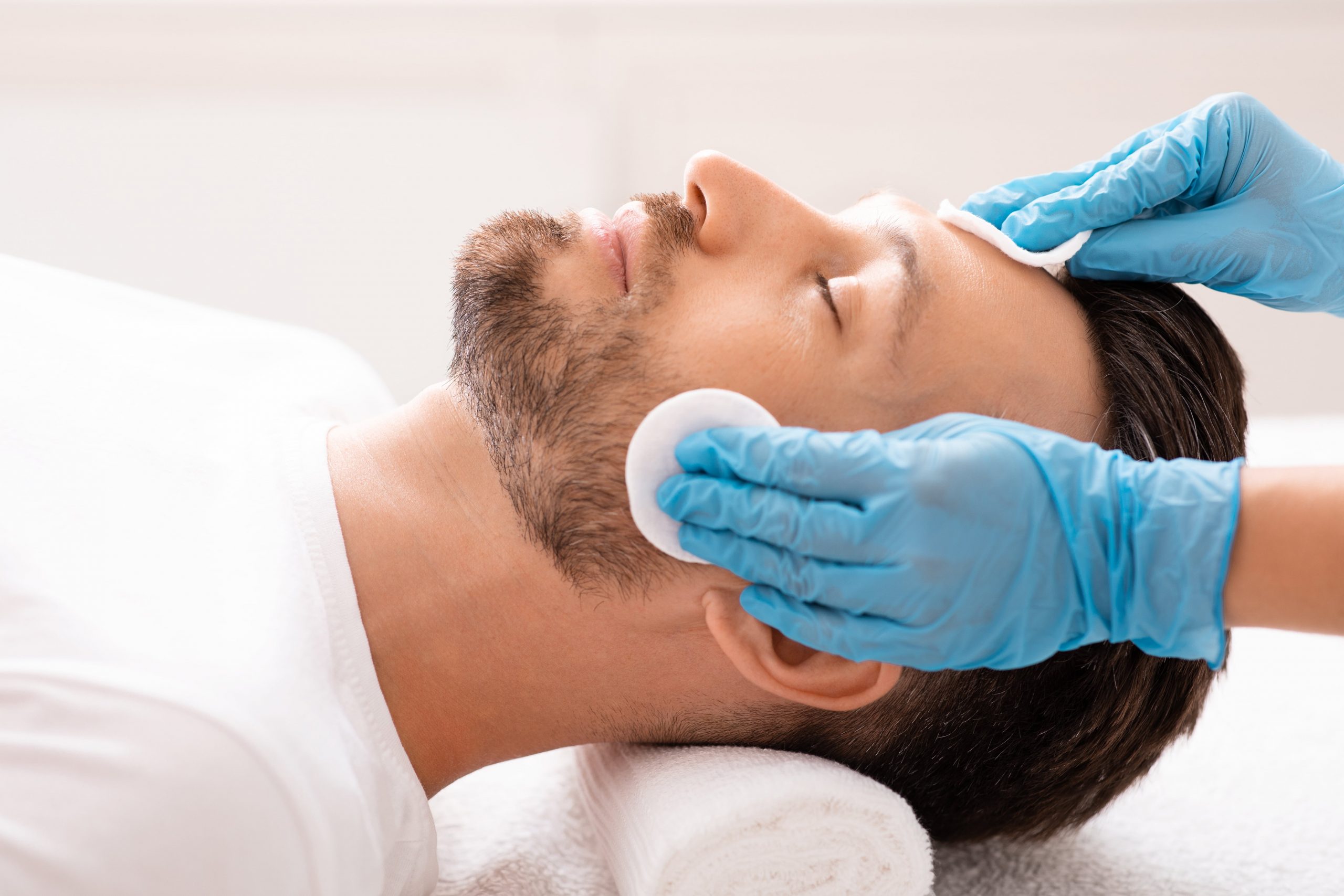
How men's skin differs biologically — and why it matters for treatment
Male skin is structurally different from female skin in ways that directly affect how conditions present and how they respond to treatment:
- Thickness: Male skin is approximately 25% thicker due to higher collagen density — this means it tolerates more aggressive treatments but also takes longer to show surface improvement
- Sebum production: Androgens drive significantly higher sebum output in male skin — making oiliness, enlarged pores, and acne more persistent and requiring sebum-control approaches rather than general hydration-focused protocols
- Hair follicle density: Higher beard and body hair density creates a different treatment surface for laser procedures — hair removal settings, injection patterns for PRP, and peel protocols are adjusted accordingly
- Shaving trauma: Daily or frequent shaving creates micro-trauma, folliculitis, ingrown hairs, and post-inflammatory pigmentation in the beard zone — a concern specific to male patients
- Sun exposure: Men in Kota typically accumulate more cumulative UV damage due to outdoor work and transport without sun protection — tanning, pigmentation, and early photoageing are common presentations
The most common skin and hair concerns in male patients at Skinssence — and what actually works
| Concern | Why it presents differently in men | Effective treatment | At Skinssence |
|---|---|---|---|
| Acne and oily skin | Higher androgen-driven sebum; thicker skin prolongs acne cycles | Medical acne treatment, salicylic peels, medical skincare | Acne treatment → |
| Hair thinning and loss | Androgenetic alopecia typically progresses faster and earlier in men | PRP or GFC PRP based on stage; medical therapy alongside | PRP → · GFC PRP → |
| Unwanted body and facial hair | Back, chest, shoulder, beard shaping — areas not typically treated in women | 4-wavelength diode laser; multiple sessions | Laser hair removal → |
| Tanning and pigmentation | Cumulative UV from outdoor exposure; shaving-related PIH in beard zone | Laser toning, salicylic + glycolic peels, sunscreen | Laser toning → · Chemical peels → |
| Razor burn and folliculitis | Shaving trauma + sebum + ingrown hairs in beard zone | Laser hair removal eliminates the root cause; medifacial for active inflammation | Medifacials → |
| Pre-wedding groom plan | Tan removal, acne, beard-area LHR, back/chest hair, scalp health | Combination plan starting 6–9 months before wedding | Groom skincare plan → |
Acne in men — why it persists and how it is treated differently
Male acne is driven primarily by androgen-stimulated sebum overproduction — the same hormonal mechanism as in women, but typically more intense and more persistent because androgen levels in men remain elevated longer into adulthood. The thicker skin structure means comedones (blocked pores) are deeper, and inflammatory acne tends to produce larger, more painful lesions.
Standard approaches that work for female hormonal acne — managing oestrogen/progesterone cycles — are not applicable in male patients. Effective medical acne treatment for men focuses on: topical and oral sebum regulation, salicylic acid-based peels for deep pore cleansing, and management of post-acne pigmentation which in Indian male skin (Fitzpatrick III–V) tends to be darker and more persistent than in lighter skin types.
Men with acne who delay treatment typically arrive with both active acne and established scarring — requiring a longer treatment course than patients who addressed the active acne earlier. See: Acne treatment at Skinssence →
Hair loss in men — when to start treatment and what to expect
Androgenetic alopecia (male pattern hair loss) is the most common hair concern in male patients at Skinssence. It typically begins at the temples and crown and progresses to involve larger scalp areas if untreated. The key clinical fact that most patients do not act on in time: PRP and GFC PRP work on follicles that are still biologically active — follicles that have been completely inactive for years cannot be restored by any non-surgical treatment. Starting treatment at moderate rather than advanced stage consistently produces better outcomes.
For early to moderate hair loss: standard PRP — 4–6 sessions, reduced shedding within 6–8 weeks, visible density improvement by 3–4 months. For moderate to progressive loss or partial PRP responders: GFC PRP — higher growth factor concentration, earlier visible response (4–6 weeks), 3–5 sessions typically needed.
Both treatments are combined with topical minoxidil and/or oral therapy for androgenetic alopecia — the medication suppresses the DHT-driven miniaturisation mechanism while PRP/GFC directly stimulates follicle activity. Neither alone is as effective as both together.
Laser hair removal for men in Kota — areas, timing, and what to expect
Laser hair removal for men at Skinssence covers a different set of areas than for women: back and shoulders (the most requested), chest, abdomen, arms, beard shaping (cheek and neck line definition without removing the beard itself), and full beard removal for men who want a permanently smooth face. The 4-wavelength diode laser at Skinssence handles all Indian skin tones and coarse dark body hair effectively — including the dense hair typical of male back and chest areas that single-wavelength lasers often treat less effectively.
For men planning laser hair removal before a wedding: starting at least 6–8 months before the wedding date ensures the complete course (6–8 sessions spaced 6–8 weeks apart) is finished before the event. Back and chest hair typically requires the full 6–8 sessions for significant reduction. Beard shaping requires fewer sessions but more precise mapping at the first consultation.
Full guide: Laser hair removal in Kota → · Full body laser hair removal cost guide →
Razor burn, folliculitis, and ingrown hairs — the shaving-related skin problems
Daily shaving creates a cycle: mechanical trauma to the follicle opening → sebum and bacteria enter → folliculitis (infected hair follicles) → post-inflammatory pigmentation → darker, uneven beard zone. This cycle is one of the most common presentations in male patients at Skinssence and is almost entirely eliminated by laser hair removal of the beard neck and cheek areas where the problem concentrates.
For patients who are not ready for laser hair removal: a salicylic acid peel course addresses the active folliculitis and post-inflammatory pigmentation; switching to a single-blade razor with proper shaving gel reduces ongoing trauma; applying a retinoid or niacinamide to the beard zone between shaves reduces follicular inflammation over time.
A basic men's daily skincare routine — the minimum effective approach
Men benefit from a simpler routine than the multi-step approaches marketed to women — but the non-negotiables are the same:
- Cleanser: gel or foam cleanser twice daily — removes sebum, sweat, and post-shave debris without stripping the barrier
- Moisturiser: lightweight, non-comedogenic — oily skin still needs moisturiser; skipping it worsens sebum rebound
- Sunscreen: broad-spectrum SPF 30+ every morning — the single most impactful skincare product for preventing tanning, pigmentation, and early skin ageing; non-negotiable in Kota's UV environment
- Post-shave: alcohol-free toner or niacinamide serum on the beard zone — reduces inflammation from shaving trauma
For prescription actives — retinoids, salicylic acid, or specific brightening agents — these are added based on clinical assessment of your specific concerns, not by default. A dermatologist consultation determines which actives your skin actually needs.
Frequently asked questions
Is laser hair removal safe for men with dark Indian skin?
Yes — the 4-wavelength diode laser at Skinssence is specifically effective for Indian skin tones (Fitzpatrick III–V) and coarse dark body hair. Settings are calibrated per session based on skin tone and hair type. All laser sessions at Skinssence are supervised by Dr. Ashima Madan. See: Laser hair removal in Kota →
Can hair loss be reversed in men?
Significantly slowed and partially reversed — not completely reversed once follicles have been permanently lost. PRP and GFC PRP produce meaningful density improvement and shedding reduction in patients who start treatment at moderate rather than advanced stage. Early treatment consistently produces better outcomes than waiting. The earlier you start, the more follicles remain active and treatable. See: PRP → · GFC PRP →
How many laser hair removal sessions do men need for back or chest?
Back and chest hair typically requires 6–8 sessions spaced 6–8 weeks apart for significant reduction. Dense coarse body hair needs the full course — it cannot be significantly reduced in 2–3 sessions regardless of the device used. A full body laser cost guide: full body LHR cost guide →
Is it normal for men to get facials and skin treatments?
Clinically, skin conditions do not distinguish by gender and neither do the treatments. At Skinssence, male patients account for a significant and growing proportion of consultations — particularly for acne, hair loss, laser hair removal, and pre-groom skincare. The concern is the same as for any patient: achieving healthy, well-maintained skin. The treatment is the same evidence-based approach regardless of who the patient is.
What skincare should grooms start before their wedding?
Start 6–9 months before the wedding for best results. Laser hair removal (back, chest, beard shaping) must start earliest — 6–8 months minimum. Acne treatment and pigmentation correction need 4–6 months. HydraFacial or carbon laser facial in the final week for surface glow. Full groom plan: groom skincare at Skinssence → · bridal skincare timeline →
Related: Laser hair removal in Kota → · PRP hair treatment → · GFC PRP → · Acne treatment → · Full body laser hair removal cost → · Groom skincare plan →
