
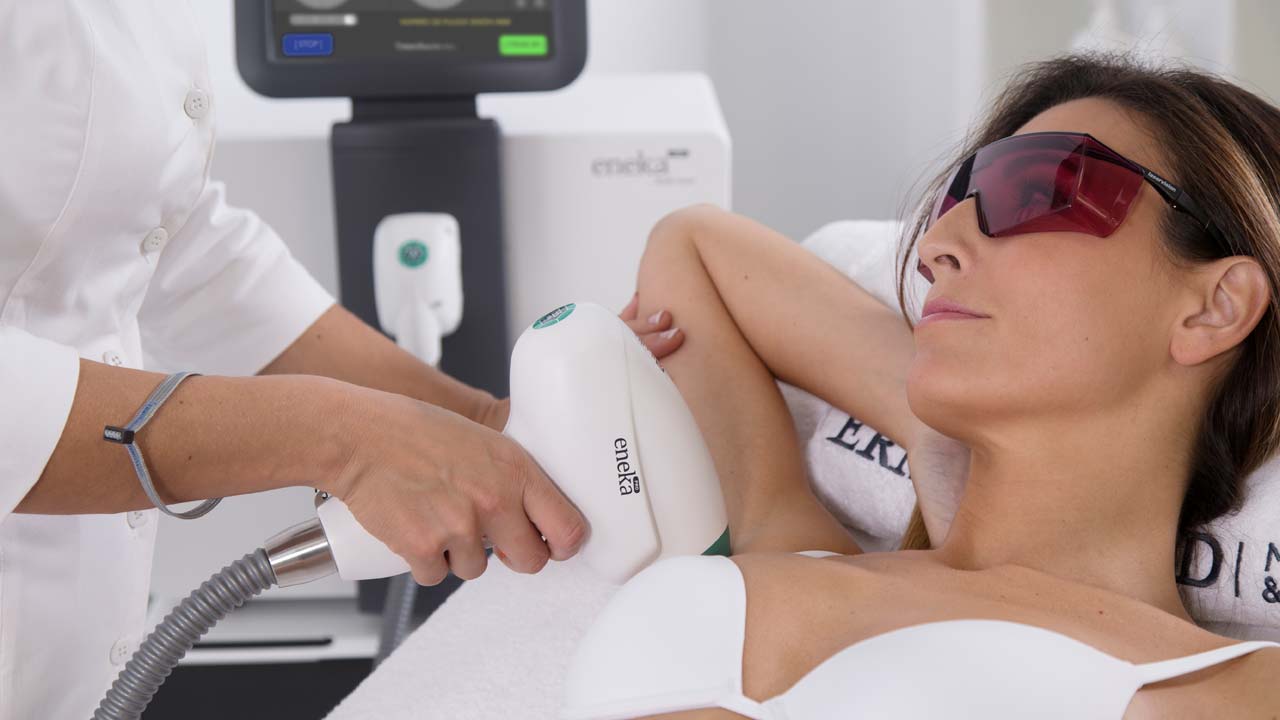
If you are exploring laser hair removal and have come across terms like IPL, diode 808, triple wavelength, or 4-wavelength laser, the differences matter — not just technically, but practically for your skin tone, hair thickness, and expected outcomes. This guide explains each technology plainly, compares them in a single table, and maps them to patient profiles common in Kota so you can arrive at your dermatologist consultation with the right questions already formed.
The short answer: technology selection depends on your skin tone, hair thickness, and whether a hormonal condition like PCOD is driving the growth. A single "best" technology does not exist for all patients — but a well-matched one does for most.
The main hair removal technologies: what each one does
IPL — Intense Pulsed Light
IPL is not a laser. It emits broad-spectrum light across multiple wavelengths, which is less precise than a dedicated laser beam. Results vary considerably depending on the contrast between hair pigment and skin tone. IPL performs most predictably on fair skin with dark coarse hair. For Indian skin tones, where higher melanin levels are common, the risk of pigmentation increases significantly if settings are not carefully controlled — and most IPL devices in non-clinical settings are not calibrated by a dermatologist.
Electrolysis
Electrolysis is the oldest method. A fine probe is inserted into each individual follicle and electrical energy destroys the root. It works on all hair colours including light or white hair — the one scenario where laser cannot help. The trade-off is time: treating each follicle individually makes it impractical for large body areas. It is best suited to small zones where a few persistent hairs remain after laser treatment.
Single-wavelength lasers: Alexandrite, Nd:YAG, Ruby
Alexandrite 755 nm targets superficial follicles effectively and works well on lighter skin tones with dark hair. It has a limited safety range on medium-to-dark Indian skin.
Nd:YAG 1064 nm penetrates deeper and has a better safety profile for darker skin types. It is one of the key wavelengths included in modern multi-wavelength platforms specifically because of this property.
Ruby laser works on fine light hair on fair skin and is rarely used as a primary tool today given the availability of more versatile platforms.
Diode 808 nm — the previous clinical standard
For many years, the 808 nm diode was the benchmark for laser hair removal. It offered meaningful improvement over IPL: true laser precision, good depth penetration for mid-depth follicles, a wider safety range across skin types, and faster sessions due to larger spot sizes. It remains a capable technology when operated correctly under dermatologist supervision.
Its limitation is single-depth targeting. When a patient has a mix of superficial and deeper follicles — common in coarse body hair, beard areas, and hormonally driven growth — the 808 nm beam misses follicles outside its primary depth range, and more sessions are needed to compensate.
4-wavelength diode — the current generation
Modern multi-wavelength platforms combine 755 nm, 808 nm, 940 nm, and 1064 nm in a single handpiece, delivered simultaneously or in rapid sequence. Superficial, mid-depth, and deep follicles are all targeted within the same pulse rather than across separate sessions designed to catch different depths.
- 755 nm — targets finer and more superficial hair
- 808 nm — the core mid-depth workhorse
- 940 nm — enhances controlled energy absorption between depths
- 1064 nm — reaches deeper follicles safely; critical for melanin-rich Indian skin
This combination is why US FDA-approved 4-wavelength platforms are now the clinical preference at dermatologist-supervised clinics. Details of the specific platform in use at Skinssence are on the technologies page.
Technology comparison at a glance
| Technology | How it works | Skin type suitability | Follicle targeting | Generation |
|---|---|---|---|---|
| IPL | Broad-spectrum light | Varied; unreliable on darker skin | Lower precision | Older |
| Electrolysis | Electrical current per follicle | All skin and hair colours | Individual follicle only | Oldest method |
| Alexandrite 755 nm | Single-wavelength laser | Best on fair skin | Superficial follicles | Earlier generation |
| Nd:YAG 1064 nm | Deep-penetrating laser | Safer for darker skin | Deep follicles | Earlier generation |
| Diode 808 nm | Single-wavelength laser | Most skin types | Mid-depth follicles | Standard generation |
| 4-Wavelength Diode | 755+808+940+1064 nm combined | Optimised for Indian skin | All depths simultaneously | Latest generation |
Diode 808 vs triple-wavelength vs 4-wavelength: the practical differences
Patients at a dermatology clinic are frequently choosing between these three laser generations. The table below focuses on factors most relevant to the decision.
| Factor | Single diode 808 nm | Triple wavelength | 4-wavelength diode |
|---|---|---|---|
| Follicle depth coverage | Mid-depth only | Superficial + deep | Superficial, mid and deep simultaneously |
| Indian skin safety | Good with supervision | Better | Optimised for melanin-rich skin |
| Thick or coarse hair | Good response | Better response | Most comprehensive targeting |
| Hormonal hair — PCOD | More sessions needed | Improved response | Enhanced multi-depth response |
| Fine hair | Limited response | Moderate | Moderate — realistic expectations needed |
| Session efficiency | Fast | Faster | Optimised energy distribution |
| Technology generation | Earlier | Advanced | Latest — current clinical standard |
For patients with PCOD-related hair growth, where follicle depth and growth phase vary more than average due to hormonal fluctuation, the multi-depth targeting of 4-wavelength platforms is particularly relevant.
Which technology suits which patient? A practical matching guide
The technology question cannot be separated from the patient profile. The same device produces different outcomes on different skin types and hair patterns. Use this table to orient yourself before consultation — not to self-prescribe a treatment plan.
| Patient profile | Best-suited technology | Clinical note |
|---|---|---|
| Fair skin, coarse dark hair | Alexandrite 755 nm or Diode 808 | Good standalone candidate |
| Medium-brown skin — most Kota patients | 4-wavelength diode | Optimal — covers multiple depths safely |
| Darker skin (Fitzpatrick V–VI) | Nd:YAG dominant or 4-wavelength | Requires expert calibration |
| PCOD or hormonal hair growth | 4-wavelength diode | Multi-depth helps; maintenance sessions likely |
| Mixed coarse and fine hair on same area | 4-wavelength diode | Single-wavelength often misses fine follicles |
| Men — beard shaping, chest or back | 4-wavelength diode | Depth variation handles thick follicles better |
| Fine light hair — any area | Any technology | Laser has limited effectiveness — manage expectations |
If you are unsure which profile applies — particularly if acne, pigmentation, or open pores are also a concern alongside unwanted hair — a combined dermatologist assessment is the most efficient first step.
Why technology choice matters specifically for patients in Kota
Most patients in Kota have skin types in the Fitzpatrick III–V range — medium to darker Indian tones where higher melanin levels mean that incorrect laser settings carry a genuine risk of pigmentation or burns. This is not a theoretical risk; it is the most common complaint dermatologists see from patients who had laser done in salon settings without proper calibration.
Patients managing skin concerns alongside hair removal — including those dealing with stretch marks, under-eye darkening, or pigmentation from previous waxing — often benefit from a single combined clinical plan rather than addressing each concern separately.
Common questions about laser technology — answered plainly
Does the number of wavelengths actually change results, or is it marketing?
It changes results for a specific subset of patients: those with mixed hair depths, darker Indian skin where 1064 nm is the safety-critical component, and those with hormonally driven growth where follicle depth is inconsistent. For a patient with uniform coarse dark hair on fair skin, a well-operated 808 nm device can still perform well. The clinical advantage of 4-wavelength technology is most apparent at the edge cases — and in Kota, where most patients fall in the mid-to-dark skin tone range, those edge cases are common.
Is a higher-generation laser device automatically safer?
Technology generation matters, but operator competence and settings matter more. A 4-wavelength platform operated without proper calibration for skin tone is more dangerous than an 808 nm device used carefully by a trained dermatologist. The technology advantage is fully realised only under medical supervision — which is why the clinical setting matters as much as the device model.
Are home IPL devices the same as clinic laser treatment?
No. Home IPL devices operate at significantly lower fluence levels than medical-grade clinic devices. They are not calibrated for Indian skin tones by a clinician, and they are not equivalent in outcome or safety to dermatologist-supervised laser treatment. Most patients who try home IPL and then come to a clinic have seen partial results and are looking for a more structured outcome.
Which laser technology is best for PCOD-related hair growth?
4-wavelength diode laser is most suitable for PCOD-related hair growth because hormonally driven follicles vary in depth and growth phase more than average. Multi-depth targeting improves response, though maintenance sessions are likely needed alongside management of the underlying hormonal condition.
What to do next
Understanding technology differences is preparation, not a substitute for clinical assessment. Your skin tone, hair thickness, hormonal history, and treatment area all determine which technology produces the best results for you — and at what settings.
The full treatment guide covering session planning, area-by-area timelines, preparation, aftercare, and cost is on the Laser Hair Removal in Kota service page. To book a consultation with Dr. Ashima Madan (MBBS, MD, FAM – DJPIMAC, Mumbai) at Skinssence Laser & Skincare Clinic, Talwandi, Kota — book online or call 9509197578.
