
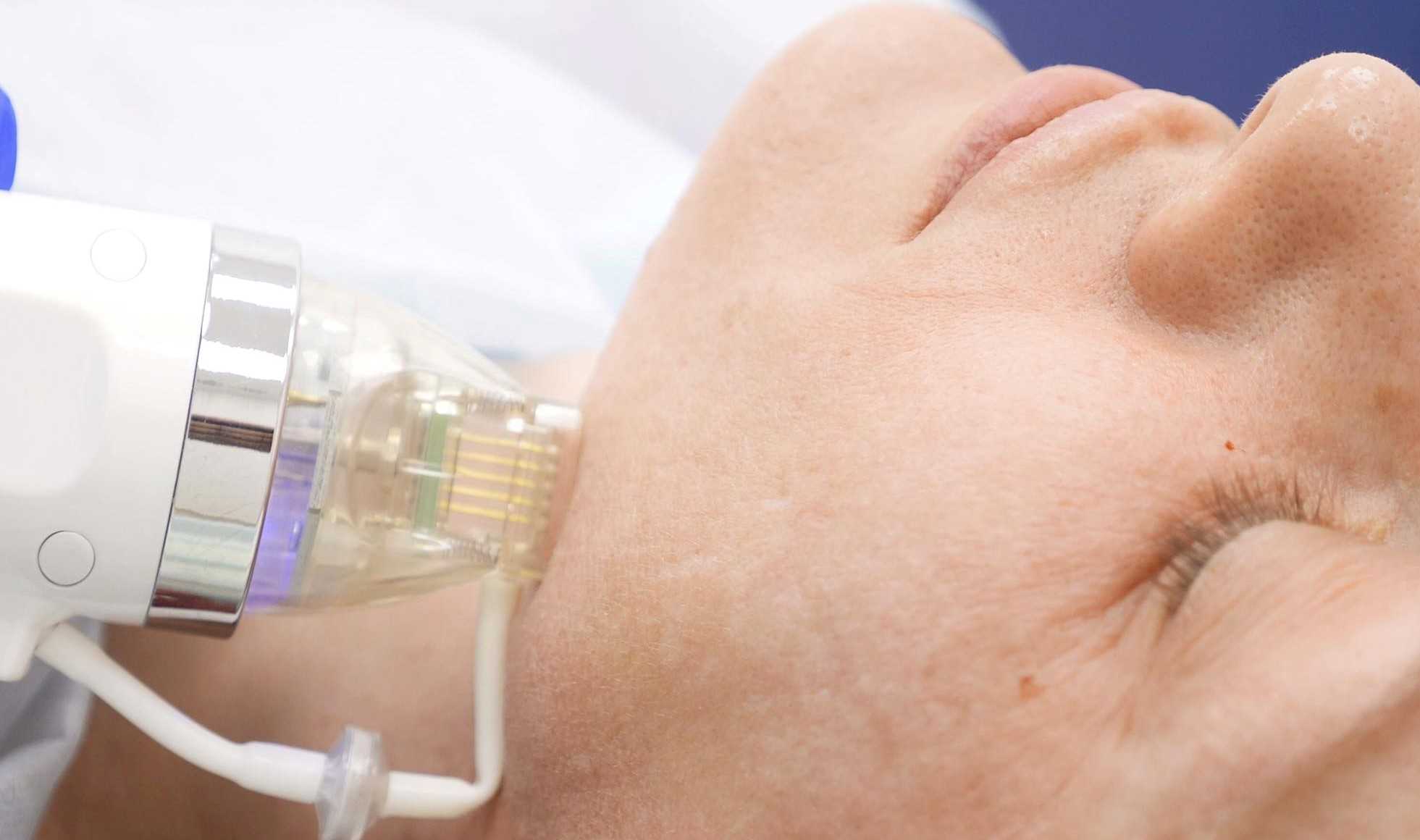
Microneedling is one of the most frequently asked-about treatments at Skinssence Laser & Skincare Clinic in Talwandi, Kota — and also one of the most frequently misunderstood. Patients arrive having heard it described as everything from a miracle scar treatment to something that simply "pokes holes in your face." This guide, written by Dr. Ashima Madan (MBBS, MD, FAM – DJPIMAC, Mumbai), explains what microneedling and Microneedling RF actually are, how they differ from each other, what each is genuinely suited for, and what a realistic treatment course looks like for Indian skin in Kota's climate.
How microneedling works — the biological mechanism
Standard microneedling — also called collagen induction therapy or CIT — uses a device with fine needles (typically 0.5mm to 2.5mm in length) that create thousands of microscopic puncture channels in the skin's surface at controlled depth. These micro-injuries are small enough to heal completely within 24–72 hours, but large enough to trigger a cascade of wound-healing responses in the skin:
- Inflammatory phase (days 1–3): The body sends growth factors and platelets to the micro-injury sites. This is the phase that feels like mild redness and warmth after the session.
- Proliferative phase (days 3–14): Fibroblasts migrate to the treated area and begin producing new collagen and elastin fibres to repair the micro-channels. This is where the actual skin improvement originates.
- Remodelling phase (weeks 2–6 months): New collagen matures and reorganises — the gradual visible improvement in skin texture, scar depth, and firmness that continues long after the session ends.
The key principle is that the body cannot distinguish between an accidental micro-injury and a controlled therapeutic one — it responds to both with the same collagen-producing repair process. Microneedling harnesses this response in a controlled, repeatable way.
Microneedling RF (MNRF) — what the radiofrequency adds
Microneedling RF combines the mechanical micro-channel creation of standard microneedling with the delivery of radiofrequency (RF) energy through insulated needles directly into the mid-to-deep dermis. This adds a second, distinct mechanism to the procedure:
While the needle tips create the mechanical micro-injury at the surface, RF energy is simultaneously discharged at the needle tip depth — creating focal thermal (heat) zones in the dermis. These thermal zones cause two additional effects that standard microneedling alone cannot produce:
- Immediate collagen contraction: Heat causes existing collagen fibres to contract and tighten — producing a mild immediate skin tightening effect visible within days of the session
- Deeper, more aggressive collagen neogenesis: The thermal injury stimulus produces a significantly stronger collagen production response than mechanical micro-injury alone — resulting in more collagen formation per session and more visible structural improvement over the treatment course
Why MNRF is the preferred option for most clinical indications at Skinssence
Standard microneedling (Dermapen) produces real collagen stimulation and is a legitimate treatment — but at Skinssence, Microneedling RF is the more commonly used modality for clinical indications because the RF energy component produces a meaningfully stronger and deeper collagen response. For moderate-to-significant acne scarring, skin laxity, or open pore treatment, MNRF consistently produces better outcomes per session than standard microneedling at the same needle depth.
Standard microneedling without RF is appropriate for: very mild textural concerns, patients with a low pain threshold where RF energy would require more anaesthesia, and as a supportive treatment alongside other procedures. For the majority of patients presenting with acne scars, open pores, or skin laxity, MNRF is the clinical recommendation at Skinssence.
Standard microneedling vs Microneedling RF — side-by-side comparison
| Factor | Standard microneedling (Dermapen) | Microneedling RF (MNRF) |
|---|---|---|
| Mechanism | Mechanical micro-channels only — collagen stimulated by wound-healing response | Mechanical micro-channels + radiofrequency thermal energy delivered at needle depth |
| Collagen depth reached | Epidermis to superficial dermis (depth of needle) | Mid-to-deep dermis — RF energy reaches beyond needle tip depth |
| Collagen stimulus strength | Moderate — sufficient for mild concerns | Strong — thermal + mechanical combined stimulus |
| Skin tightening effect | Minimal immediate tightening | Visible immediate tightening from thermal collagen contraction |
| Best for | Mild textural irregularity, surface hydration enhancement, very mild scarring | Moderate-to-significant acne scars, open pores, skin laxity, stretch marks, anti-ageing |
| PIH risk in Indian skin | Lower — mechanical injury only, less inflammatory response | Slightly higher if settings are too aggressive — managed with correct parameters and skin preparation |
| Sessions typically needed | 4–6 for mild concerns | 3–5 for moderate concerns — fewer sessions needed due to stronger per-session response |
| Downtime | 1–2 days mild redness | 2–4 days redness and mild swelling — no peeling, no social restriction after day 3 |
| Pain level | Mild — topical anaesthetic applied | Moderate — topical anaesthetic applied 30–45 minutes before; manageable during session |
What microneedling and MNRF treat — and what they do not
Acne scarring — the primary indication
MNRF — primary treatmentMNRF is the most effective non-invasive treatment for atrophic acne scars — rolling scars and boxcar scars specifically. The RF energy at depth disrupts the fibrous bands tethering rolling scars to subcutaneous tissue while simultaneously stimulating new collagen to fill the volume deficit. For ice pick scars, MNRF is used as an adjunct to TCA CROSS rather than as a primary treatment. For the full scar-type to treatment matching guide, see how to choose the right acne scar treatment in Kota.
Open pores and skin texture
MNRF — primary treatmentEnlarged pores respond well to MNRF because the thermal collagen contraction tightens pore walls from within the dermis — a mechanism that surface treatments cannot achieve. Improvement in pore size is often visible within 2–4 weeks of the first session. See open pore treatment at Skinssence.
Skin laxity and early anti-ageing
MNRF — effectiveMNRF is the most effective non-surgical treatment for mild-to-moderate skin laxity. The deep collagen remodelling and immediate tightening effect address the structural collagen deficit that surface treatments cannot reach. Often combined with PRP or GFC for maximum collagen response. See the full guide on anti-ageing treatments in Kota.
Stretch marks
MNRF — effective for early/red stretch marksEarly stretch marks (red or purple — striae rubra) respond better to MNRF than established white stretch marks (striae alba), where the collagen deficit is more extensive. MNRF produces meaningful improvement in texture and depth, though complete elimination is uncommon for severe established stretch marks. See stretch mark treatment at Skinssence.
Post-inflammatory hyperpigmentation (dark marks after acne)
Standard microneedling — supportive role onlyFlat dark marks after acne healing are pigmentation — not structural scarring. They do not have a collagen deficit. MNRF and standard microneedling are not primary treatments for PIH. Chemical peels and laser skin toning are more effective. Microneedling's role here is limited to enhancing absorption of topical brightening agents through the micro-channels — useful as an adjunct, not a primary treatment. See pigmentation treatment at Skinssence.
Active acne
Contraindicated — do not use over active lesionsMNRF and standard microneedling are contraindicated over actively inflamed or infected acne lesions. Needling over active acne spreads bacterial infection, worsens inflammation, and can produce significant new scarring. Active acne must be brought under control with prescription treatment before any needling procedure begins. See acne treatment at Skinssence.
Indian skin and MNRF — why calibration matters
Indian skin (Fitzpatrick III–V, which describes the majority of Kota patients) has higher baseline melanin content and more reactive melanocytes than lighter skin types. Any inflammatory stimulus — including controlled therapeutic injury — can trigger excess melanin production, causing post-inflammatory hyperpigmentation at the treatment sites.
Specifically, Dr. Ashima Madan's protocol for MNRF at Skinssence includes:
- Pre-treatment priming: Topical agents applied in the weeks before the first session to reduce melanin reactivity and prepare the skin barrier
- Conservative depth and energy settings: Parameters calibrated for Indian skin at each session — not a fixed standard setting applied to every patient regardless of Fitzpatrick type
- Post-procedure sun protection: Strict SPF guidance for the 5–7 days following each session — mandatory, not optional. Kota's UV environment makes this particularly critical
- Session spacing: Minimum 4–6 weeks between sessions to allow complete collagen maturation from the previous session before re-stimulating
What a Microneedling RF session at Skinssence involves — step by step
For patients attending their first MNRF session, knowing what to expect removes a significant amount of anxiety from the experience. The session at Skinssence follows this sequence:
- Topical anaesthetic application (30–45 minutes before): A numbing cream is applied to the treatment area and left to take full effect. This is the step that makes the difference between an uncomfortable experience and a manageable one — adequate contact time for the anaesthetic is not negotiable.
- Skin preparation and cleansing: The anaesthetic is removed, the skin is cleansed thoroughly, and the treatment area is prepared. Any active lesions or recent skin damage are noted and avoided.
- MNRF treatment passes: The device delivers controlled passes across the treatment area at the planned depth and RF energy settings. Most patients describe the sensation as a warm pressure — not sharp pain. The total treatment time for a full face is typically 30–45 minutes.
- Immediate post-treatment care: A soothing serum or growth factor concentrate is applied immediately after — this is the optimal window for active ingredient absorption, since the micro-channels are open and receptive. At Skinssence, PRP or GFC is frequently applied at this stage for patients whose plan includes it.
- Protective finishing: A calming mask and mineral SPF are applied before the patient leaves the clinic.
- Post-care briefing: Clear instructions on the 5–7 days following treatment — what to apply, what to avoid, and SPF requirements. This briefing is as important as the procedure itself for Indian skin outcomes.
Immediately after the session, the skin appears red and feels warm — similar to moderate sunburn. This settles significantly within 24 hours and is typically resolved by day 2–3. There is no visible peeling, no open wounds, and no social restriction beyond the initial redness period.
What to expect across a treatment course — realistic improvement timelines
| Concern | Sessions typically needed | When improvement becomes visible | Realistic outcome |
|---|---|---|---|
| Rolling acne scars | 4–6 MNRF sessions | Visible improvement from session 3; clearest result at 3–6 months after final session | 50–70% textural improvement — most responsive scar type to MNRF |
| Shallow-moderate boxcar scars | 4–6 MNRF sessions | Gradual softening of scar walls from session 2–3 onwards | 40–60% depth reduction; visible surface smoothing |
| Open pores | 3–4 MNRF sessions | Often visible within 2–3 weeks of first session | Significant visible pore size reduction; maintenance sessions 2–3x per year |
| Mild-moderate skin laxity | 3–4 MNRF sessions | Mild tightening visible within 2 weeks; progressive over 3 months | Meaningful firmness improvement; best in mild laxity |
| Stretch marks (early) | 4–6 MNRF sessions | Texture improvement from session 2–3 | Significant improvement in texture and depth; colour normalisation |
"The question patients ask most often before MNRF is how many sessions they need. My honest answer is always: it depends on what we are treating and how your skin responds — which I can only assess after your first session. What I can tell you before we start is this: collagen remodelling has a biological speed limit. The full result of a session takes 3–4 months to express completely. Patients who judge the treatment after one session and two weeks are not seeing what the treatment has done — they are seeing the beginning of a process that will continue without their awareness for months. Patience with this procedure is not just advice; it is understanding how biology works."
— Dr. Ashima Madan (MBBS, MD, FAM – DJPIMAC, Mumbai), Skinssence Laser & Skincare Clinic, KotaCombination protocols — MNRF with PRP or GFC
One of the most consistent clinical findings in microneedling practice is that combining MNRF with immediately post-procedure application of PRP or GFC produces significantly better outcomes than MNRF alone. The mechanism is straightforward: MNRF creates thousands of micro-channels through which growth factors in PRP and GFC can penetrate directly to the dermal layer where collagen production is being stimulated — achieving absorption depths that topical application on intact skin cannot approach.
At Skinssence, MNRF combined with PRP treatment or GFC treatment is the standard recommendation for patients with moderate-to-significant acne scarring — the combined approach consistently produces faster visible improvement and better final outcomes per session than MNRF alone. The PRP or GFC preparation is done at the same appointment, applied immediately after the MNRF passes while the channels are open — no additional clinic visit required.
Who should not have MNRF without assessment first
- Active acne or open skin infections — must be controlled before any needling procedure
- Active inflammatory skin conditions (rosacea flare, active eczema) — requires modification or postponement
- Pregnancy — MNRF is not recommended during pregnancy
- Recent isotretinoin use — MNRF is deferred for 6 months after stopping isotretinoin
- Keloid or hypertrophic scar tendency — MNRF is contraindicated for raised scarring; see the full explanation in the acne scar treatment guide
- Very sensitive or reactive skin — modified parameters and patch testing first; see sensitive skin treatment at Skinssence
All of these are identified at the initial consultation — which is why assessment always precedes treatment at Skinssence.
Frequently asked questions about microneedling in Kota
What is the difference between microneedling and Microneedling RF?
Standard microneedling creates mechanical micro-channels in the skin that trigger a collagen-producing wound-healing response. Microneedling RF adds radiofrequency energy delivered at the needle tip depth — producing a thermal injury zone in the mid-to-deep dermis that creates a significantly stronger collagen remodelling stimulus than mechanical injury alone. MNRF also produces immediate collagen contraction for mild skin tightening. For most clinical indications at Skinssence — acne scars, open pores, skin laxity — MNRF is the preferred option because it produces better outcomes per session than standard microneedling.
Is MNRF painful?
With properly applied topical anaesthetic — which at Skinssence means 30–45 minutes of contact time, not 10–15 — the procedure is manageable for most patients. The sensation during the procedure is typically described as warm pressure rather than sharp pain. Deeper settings on areas with thinner skin (around the eyes, forehead) produce more sensation. The 24 hours after the session feel similar to moderate sunburn — warm, slightly tender skin that settles significantly by day 2.
How many MNRF sessions will I need for acne scars?
Most patients with moderate atrophic acne scarring (rolling and boxcar scars) benefit from 4–6 sessions spaced 4–6 weeks apart. The exact number depends on scar severity, depth, and how your skin responds after the first 1–2 sessions — which is why an honest session estimate requires seeing your scar pattern in person rather than giving a number before assessment. The full result of each session takes 3–4 months to express, so the clearest improvement from a complete course is visible 3–6 months after the final session. See the complete guide: acne scar treatment in Kota.
Is MNRF safe for Indian skin?
Yes — when performed at correctly calibrated settings under dermatologist supervision. The main risk in Indian skin (Fitzpatrick III–V) is post-inflammatory hyperpigmentation at needle point locations — small dark spots that are temporary but can last 4–8 weeks if they occur. This is prevented at Skinssence through pre-treatment priming agents, conservative energy parameters calibrated for your skin tone at each session, and strict post-procedure SPF guidance. These are protocol requirements, not optional extras.
Can I have MNRF if I still have active acne?
Not over actively inflamed or infected areas. MNRF on active acne spreads infection and worsens the outcome. The standard approach is to bring active acne under adequate control with prescription treatment first — typically 6–8 weeks — and then begin MNRF for the scarring. This is not a delay tactic; it is the protocol that produces the best final result. See acne treatment at Skinssence for the active acne management approach.
How long is the downtime after MNRF?
2–4 days of redness and mild warmth — similar in appearance to moderate sunburn. Most patients are comfortable returning to office work by day 3, where the redness has significantly reduced. There is no peeling, no open wounds, and no visible crusting with correctly performed MNRF. Makeup can typically be applied from day 3–4 if needed. Outdoor activity and vigorous exercise are deferred for 48 hours. Strict SPF is required starting the day after the session.
Can MNRF be combined with other treatments at Skinssence?
Yes — and for most patients with acne scarring, it should be. MNRF combined with PRP or GFC applied immediately post-procedure produces the best outcomes for acne scars. MNRF for scar remodelling is also frequently run alongside chemical peels for surface pigmentation (the PIH component of post-acne marks) and laser toning for overall skin brightness. The combination plan and timing are designed at consultation — some combinations require specific intervals between sessions to avoid over-stimulating the skin.
Clinic hours: Mon–Sat 11:00 am – 1:30 pm & 4:00 pm – 7:30 pm | Sunday 11:00 am – 1:30 pm
