
Clinical Snapshot
- Primary Concern: Severe Diffuse Facial Hyperpigmentation with Acne-Scar Textural Irregularities
- Supervising Physician: Dr. Ashima Madan
- Location: Skinssence Laser & Skincare Clinic, Talwandi, Kota
Understanding the Concern: Severe Diffuse Facial Hyperpigmentation
Some pigmentation presents as a few defined patches. This case was very different.
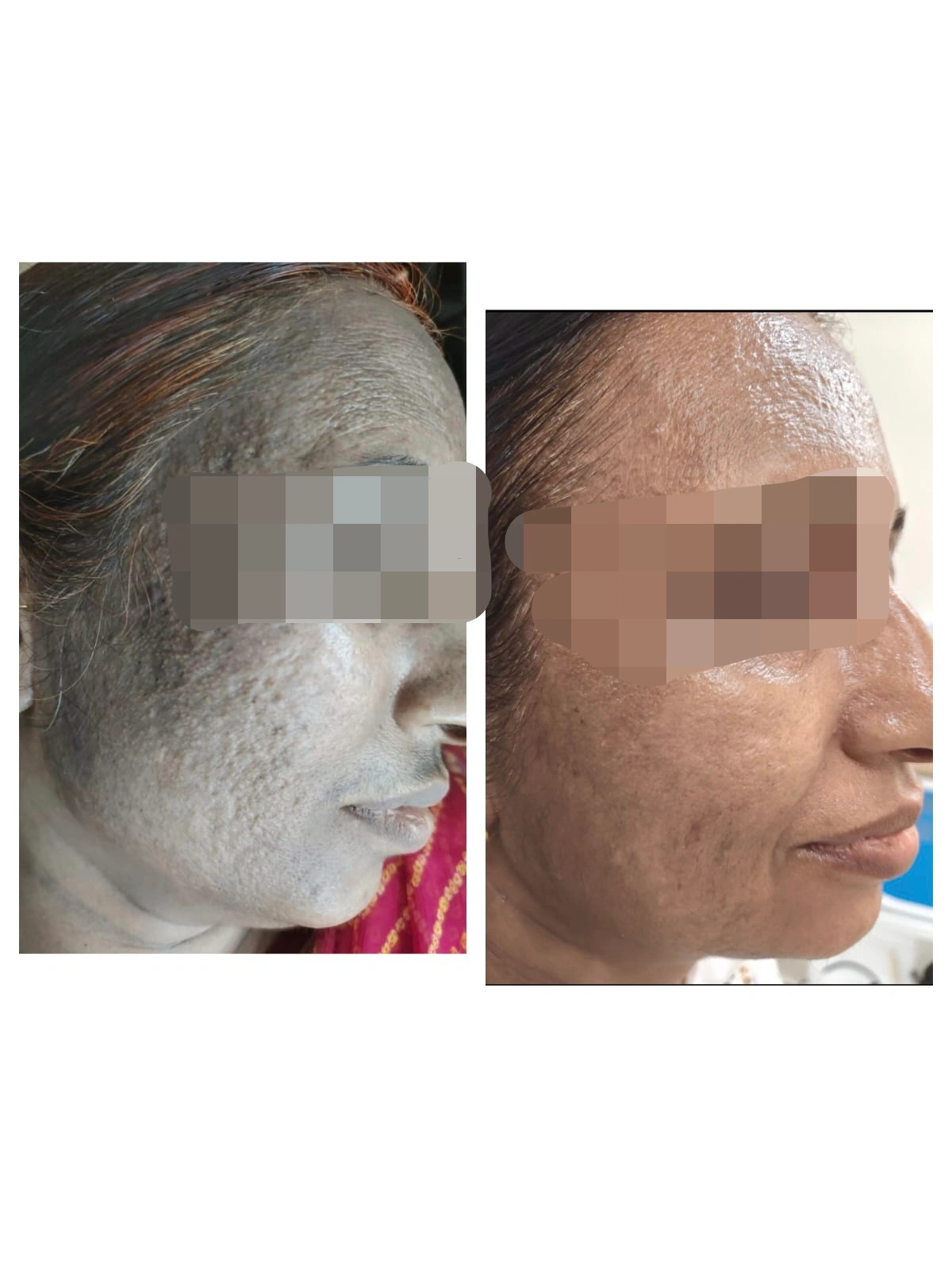
The patient presented with marked, diffuse and relatively uniform facial hyperpigmentation involving almost the entire face and forehead. The degree of pigmentation was striking in the baseline clinical photographs, with a substantial difference between her natural facial appearance and the surrounding skin.
Alongside the pigmentation, she also had residual acne scar-related textural irregularities.
For the patient, the pigmentation had become the dominant cosmetic concern. After living with it for several years, she wanted more than a temporary cosmetic improvement. She wanted her facial skin to look naturally more even again.
History of Persistent Pigmentation
The 38-year-old patient had previously undergone dermatological treatment for acne scars approximately three years earlier. Following that treatment period, she developed persistent generalized facial pigmentation.
The pigmentation subsequently remained resistant despite attempts with chemical peels. Instead of isolated dark patches, the face developed a strikingly diffuse and relatively uniform increase in pigmentation.
By the time she consulted Dr. Ashima Madan at our Talwandi clinic, the problem had become a source of considerable frustration and loss of confidence.
Why This Was a Challenging Case
The severity and uniformity of the pigmentation, its long duration and the history of inadequate response to previous procedures made this a particularly challenging case.
In pigment-prone skin, simply increasing the intensity of a procedure is not necessarily the answer. Excessive inflammation can itself contribute to further pigmentation.
Therefore, the treatment strategy focused on controlled skin remodelling, progressive pigment reduction and maintaining the integrity of the skin barrier.
Dr. Ashima Madan's Customized Treatment Strategy
After detailed clinical assessment, a phased treatment protocol was developed according to the patient's skin condition and response.
- Initial Microneedling-Based Treatment: Controlled microneedling was performed using a customized medical formulation selected for its role in supporting pigment control and skin remodelling. The treatment parameters were carefully adjusted to minimize unnecessary inflammation.
- Progressive Skin Remodelling: The treatment was continued gradually rather than aggressively. The patient's skin was assessed at each visit before proceeding with subsequent treatment.
- GFC-Based Rejuvenation: As the treatment journey progressed, Growth Factor Concentrate (GFC treatment) was incorporated as part of the overall regenerative skin-rejuvenation strategy.
- Eight GFC Sessions: A total of 8 GFC sessions were completed, with treatment progression guided by the patient's clinical response.
A Remarkable Photographic Transformation
The baseline photographs showed an unusually high degree of diffuse pigmentation. The entire face and forehead appeared markedly darker and unusually uniform in pigmentation, creating a striking contrast with the patient's eventual post-treatment appearance.
The improvement did not occur overnight.
During the initial sessions, the changes were gradual and the patient had to be repeatedly reminded that longstanding pigmentation cannot always be corrected within a few weeks.
However, serial clinical photographs began to demonstrate a clear reduction in pigmentation intensity.
By approximately the fifth treatment session, the difference had become clinically obvious. The excessive pigmentation had reduced substantially, and the patient's face had moved from a markedly hyperpigmented appearance towards a much more natural and even-looking complexion.
Further sessions were continued to consolidate the improvement and optimize overall skin quality.
From a Difficult Beginning to a Satisfying Outcome
When the baseline and subsequent photographs are viewed together, the transformation is striking.
The change is not simply a small difference in brightness. There was a substantial reduction in the overall intensity and uniformity of facial pigmentation.
For the patient, however, the most meaningful change was not the photograph itself. It was being able to look at her face without the same level of concern that had accompanied her for years.
For Dr. Ashima Madan, the case was equally rewarding because the improvement was achieved through a controlled, progressive approach rather than aggressive treatment.
Post-Procedure Care & Long-Term Maintenance
Because pigmentation has a natural tendency to recur, particularly in susceptible skin, maintenance was considered an essential part of the treatment rather than an optional step.
- Consistent daily use of broad-spectrum sunscreen.
- Appropriate sun and heat protection.
- Individualized medical skincare for pigmentation control and skin-barrier support.
- Avoidance of unnecessary irritation, aggressive scrubbing and unsupervised peels.
- Regular clinical follow-up and maintenance treatment when indicated.
Clinical Outcome & Takeaway
After completion of the treatment journey, the patient demonstrated a striking reduction in diffuse facial hyperpigmentation with significant improvement in overall skin uniformity and texture compared with her baseline photographs.
The improvement became progressively apparent during treatment and was particularly noticeable after approximately five sessions. Eight GFC sessions were subsequently completed as part of the overall skin-rejuvenation protocol.
Both the patient and Dr. Ashima Madan were satisfied with the final clinical outcome.
This case also demonstrates why difficult pigmentation should not always be approached with increasingly aggressive procedures. Sometimes the better strategy is to understand the skin, modify the treatment plan, proceed gradually and allow sufficient time for the biological response to become visible.
Dr. Ashima Madan emphasizes that such results cannot be guaranteed for every patient. The response to pigmentation treatment varies according to skin type, underlying cause, duration of pigmentation, previous procedures, individual biology, sun exposure and adherence to maintenance care. Explore our Case Studies hub or book a consultation with our specialist team today.
