
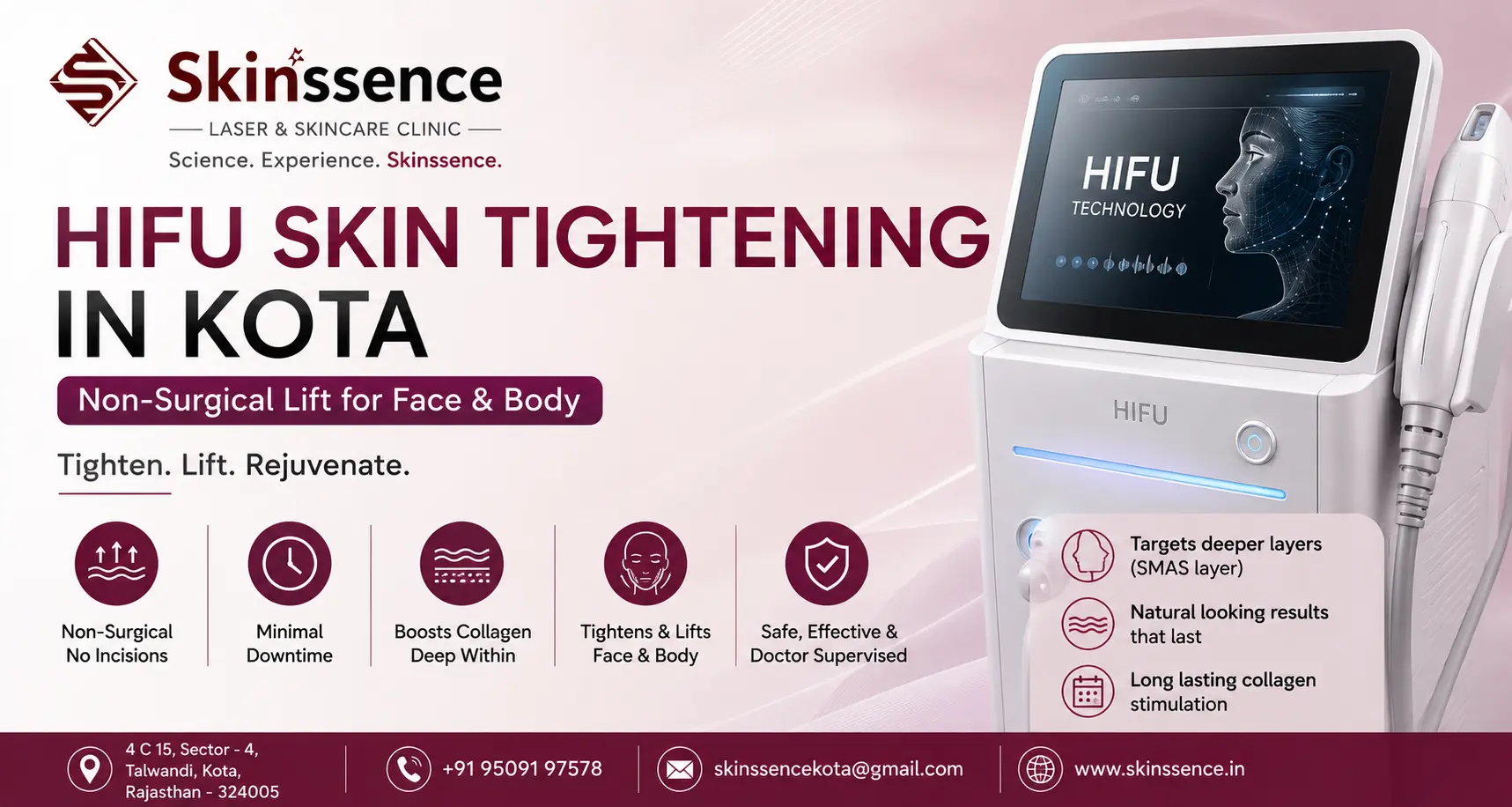
HIFU Skin Tightening in Kota by Dr. Ashima Madan
HIFU Skin Tightening in Kota
— Non-Surgical Lift for Face & Body
Doctor-supervised HIFU with RF at Skinssence, Talwandi — energy depth and protocol calibrated by clinical skin assessment, not a fixed machine setting. No surgery, no incisions, minimal downtime.
Book Consultation →Most patients asking about HIFU in Kota fall into a few groups: they've noticed early sagging along the jawline or under the chin and want to address it before it progresses; they've lost weight and are left with loose skin on the abdomen, arms or thighs; or they're comparing HIFU against a surgical facelift and want a non-surgical option first. A smaller group have already tried RF-only devices at a salon and didn't see a meaningful change. In almost every case, the outcome depends on whether the treatment depth and protocol were matched to what the skin actually needs — which is a clinical decision, made at assessment, not a preset routine.
Patients looking for HIFU treatment in Kota will find that sessions at Skinssence begin with a skin and laxity assessment that determines whether HIFU is appropriate at all, and if so, at what depth and in combination with what else.
Is HIFU the Right Treatment for You?
The most common mistake is booking HIFU for a concern it isn't built to treat — either expecting surgical-level correction from a non-surgical device, or using it where fat, not skin laxity, is the real issue. This guide maps concern to the correct approach before any session is planned.
Your concern → What is actually appropriate
Based on clinical assessment at Skinssence, Kota
| Your concern | HIFU appropriate? | Correct treatment path |
|---|---|---|
| Early jowls, softened jawline | Yes — primary use | HIFU (SMAS-depth) ± RF, face protocol |
| Double chin from mild skin laxity | Yes | HIFU + RF, submental protocol |
| Neck skin laxity ("tech neck") | Yes | HIFU + RF, neck protocol |
| Post-weight-loss skin — arms, abdomen, thighs | Yes | Body HIFU + RF, area-specific protocol, often staged over 2–3 sessions |
| Post-pregnancy abdominal skin laxity | Yes — with assessment | Body HIFU + RF; combined with stretch mark treatment if marks are also present |
| Wanting to delay or complement a future facelift | Yes | HIFU as a non-surgical option or surgical-prejuvenation step |
| Double chin from fat volume, minimal skin laxity | Partial | Assessed separately — HIFU tightens skin, it does not meaningfully reduce fat volume |
| Volume loss — hollow cheeks, deep static folds | Partial | HIFU tightens; volume restoration is a separate discussion at consultation |
| Fine surface lines only, no true laxity | Partial | Chemical peel or laser toning may be the more appropriate first step |
| Severe, extensive excess skin (post-massive-weight-loss) | No | Surgical consultation — this is outside what any non-surgical device can correct |
| Active acne or skin infection in the treatment area | No | Medical acne treatment first |
| Pigmentation, melasma | No | Melasma and pigmentation treatment |
What HIFU Does Not Do
⚠ HIFU will not address the following
- Significant excess or hanging skin — HIFU tightens tissue through collagen stimulation; it cannot remove or excise loose skin the way surgery can
- Fat volume — a double chin or body area driven mainly by fat, not skin laxity, will not visibly reduce from HIFU alone; this distinction is made at assessment
- Volume loss — hollow cheeks or deep static folds need volume restoration, not tightening; HIFU can be part of a broader plan but isn't the fix for volume on its own
- Immediate dramatic change — visible tightening builds over 8–12 weeks as new collagen forms; a session does not produce an instant "after" photo result
- Permanent aging-proofing — results last roughly 12–18 months on average; skin continues to age normally afterward, and maintenance sessions are part of the realistic plan
HIFU + RF — How the Combination Works, and Why Calibration Matters
HIFU and RF are not interchangeable, and using them well means knowing when each one is doing the work.
HIFU reaches the structural layer — the same one surgeons lift
Focused ultrasound energy is delivered at depths of roughly 1.5mm, 3.0mm and 4.5mm depending on the area. The 4.5mm depth reaches the SMAS layer — the same fibrous tissue layer addressed in a surgical facelift — triggering a controlled healing response that lays down new collagen over the following weeks.
RF adds superficial tightening and improves comfort
Radiofrequency heats the more superficial dermis, improving skin texture and adding a tightening effect closer to the surface. It's also used to make the overall session more comfortable and is particularly useful on body areas where skin quality, not just laxity, is a concern.
Depth and energy are set per patient, not per machine default
Skin thickness, degree of laxity, and area being treated (face vs. neck vs. body) determine which depths are used and at what energy. The same device produces very different results depending on whether this is calibrated correctly — this is a clinical decision made at assessment.
Indian skin needs energy levels calibrated to avoid thermal pigmentation
Fitzpatrick 3 and 4 skin — the predominant skin type among Kota patients — is more prone to post-inflammatory pigmentation from miscalibrated thermal treatments than lighter skin types. Energy settings and pass technique are adjusted accordingly at Skinssence, and this adjustment is not optional.
Who Benefits from HIFU at Skinssence — Face, Neck & Body
Jawline definition & early jowls
The most common and most reliable indication. Patients in their 30s–50s noticing a softer jawline outline respond well, since HIFU works best on mild-to-moderate laxity rather than advanced sagging.
Double chin (skin-laxity type)
When submental fullness is driven by loose skin rather than fat volume, HIFU + RF tightens the area visibly over several weeks. This distinction — skin versus fat — is made at assessment before treatment.
Neck laxity
Neck skin ages differently from facial skin and often shows laxity earlier. A dedicated neck protocol at a shallower depth addresses this without over-treating the more delicate tissue there.
Arms (upper arm laxity)
Common after weight loss or with age-related skin laxity. Body HIFU + RF on the upper arms is typically staged across 2–3 sessions for a visible improvement in skin firmness.
Abdomen
For post-pregnancy or post-weight-loss abdominal skin laxity without significant excess skin. Where stretch marks are also present, this is addressed alongside a stretch mark treatment plan.
Thighs
Inner and outer thigh skin laxity, particularly after weight loss, responds to a body HIFU + RF protocol. Results are cumulative and assessed session to session.
Non-surgical facelift alternative or "prejuvenation"
For patients who want to address early laxity before it progresses, or who want to delay (not necessarily avoid) a future surgical facelift, HIFU is one of the most established non-surgical options available.
Brow & eye area lift
A focused HIFU pass along the brow can produce a subtle lifting effect on mild upper-eyelid hooding. This is assessed individually — it is a modest effect, not a substitute for a surgical brow or lid lift.
Skin quality maintenance for existing patients
Patients already on a skincare or laser plan sometimes add HIFU as an annual maintenance step to support the structural layer, alongside surface-level treatments like peels or laser toning.
What Happens During a HIFU Session at Skinssence
The sequence is consistent. What changes from patient to patient is the depth, energy and area combination — decided at assessment, not applied as a default.
Clinical assessment
Degree of laxity, skin thickness, area(s) of concern and any contraindications (pregnancy, pacemaker or implanted devices, recent fillers or threads in the area, active infection) are checked before anything is planned.
Cleansing & marking
The treatment area is cleansed and, for facial protocols, marked to guide consistent, even coverage across the zone being treated.
Topical numbing (if needed)
For facial and neck protocols, a topical anaesthetic is applied for comfort, particularly at the deeper 4.5mm setting where sensation is more noticeable. Body areas are generally more tolerable and may not require numbing.
HIFU passes at calibrated depths
Ultrasound gel is applied and the device delivers focused energy in a grid pattern at the depth(s) indicated for that area — typically 4.5mm for the deep structural layer, with 3.0mm and 1.5mm passes added depending on the protocol.
RF pass for surface tightening
Radiofrequency is applied over the same area to address superficial skin quality and improve overall comfort and tightening — this step is what distinguishes the combination protocol from HIFU alone.
Cooling, soothing gel & SPF
A calming gel is applied to reduce any post-treatment warmth or redness, followed by sunscreen for facial and neck areas exposed to daylight. Aftercare guidance is given before the patient leaves.
HIFU + RF Protocols — Face, Double Chin & Body
Full-face HIFU + RF
Cheeks, jawline and jowls treated across the 4.5mm and 3.0mm depths, with an RF pass for surface tightening. The most requested protocol, typically one session with visible improvement building over 8–12 weeks.
Submental & neck protocol
A focused protocol for the chin-to-neck area and the neck itself, at calibrated shallower depths appropriate for thinner skin. Assessed separately from facial protocols and often combined with them in the same visit.
Body HIFU + RF
Higher-energy protocol suited to thicker body skin. Typically staged across 2–3 sessions spaced 4–6 weeks apart for arms, abdomen and thighs, with response assessed between sessions.
When HIFU is combined with other treatments
For overall skin quality alongside tightening — combined with chemical peels or laser skin toning. For post-pregnancy abdominal skin with stretch marks — alongside stretch mark treatment. Timing and spacing between HIFU and other procedures is confirmed at consultation.
Sessions, Downtime & Aftercare
Face & neck — typically one session
A single well-calibrated session is usually sufficient for face and neck laxity, with results building over 8–12 weeks and continuing to refine up to around six months. An annual maintenance session is a reasonable plan for most patients.
Body areas — usually staged
Arms, abdomen and thighs typically need 2–3 sessions spaced 4–6 weeks apart for a visible result, since body skin is thicker and the treated surface area is larger.
Downtime
Minimal. Mild redness, warmth, tingling or slight swelling for 24–48 hours is normal and settles on its own. Most patients resume their normal routine the same day.
Aftercare
Daily SPF on treated facial and neck skin, avoiding harsh actives or exfoliants for a few days post-session, and staying hydrated support the collagen-building process. Specific aftercare guidance is given after every session based on the area treated.
HIFU Pricing at Skinssence, Kota
| Protocol | Area covered | Appropriate for | Starting price |
|---|---|---|---|
| Face HIFU + RF | Full face — cheeks, jawline, jowls | Early sagging, jawline definition | Confirmed at consultation |
| Double chin & neck protocol | Submental area and neck | Double chin (skin-laxity type), neck laxity | Confirmed at consultation |
| Body HIFU + RF (per area) | Arms / abdomen / thighs | Post-weight-loss or age-related skin laxity | Confirmed at consultation |
Exact pricing depends on the area(s) treated, number of passes required, and whether HIFU alone or HIFU + RF is indicated — confirmed after skin assessment.
Clinic Details — Skinssence, Talwandi, Kota
Questions Patients Ask About HIFU in Kota
What is HIFU treatment?
HIFU (High-Intensity Focused Ultrasound) is a non-surgical skin-tightening treatment that delivers focused ultrasound energy to the deep structural layer of the skin — the same layer addressed in a surgical facelift — triggering new collagen production. At Skinssence it's combined with RF (radiofrequency) for additional superficial tightening, under Dr. Ashima Madan's supervision with depth and energy calibrated at assessment.
Is HIFU the same as a facelift?
No. HIFU works at the same tissue layer a surgical facelift addresses, but through a non-surgical, non-invasive process rather than cutting and repositioning tissue. It produces a genuine tightening effect but not the same magnitude of correction as surgery — it's best suited to mild-to-moderate laxity, not extensive excess skin.
Does HIFU hurt?
Most patients describe a warm, tingling or brief prickling sensation during the deeper passes rather than sharp pain. Topical numbing is used for facial and neck protocols to keep the session comfortable, particularly at the deeper setting.
How is HIFU different from RF-only treatments?
RF alone heats the superficial layers of skin and improves texture and mild tightening. HIFU reaches a deeper structural layer that RF does not, producing a more meaningful lifting effect. Combining both — HIFU for depth, RF for surface tightening and comfort — is why the protocol at Skinssence uses them together rather than RF alone.
Can HIFU treat a double chin?
It depends on the cause. If the double chin is mainly loose skin, HIFU + RF at a submental protocol tightens the area visibly over several weeks. If it's mainly fat volume with minimal skin laxity, HIFU will not meaningfully reduce it — this distinction is made at clinical assessment before treatment is planned.
Can HIFU be done on the body — arms, abdomen, thighs?
Yes. Body HIFU + RF is used for skin laxity on the upper arms, abdomen and thighs, particularly after weight loss or pregnancy. Body protocols are typically staged across 2–3 sessions spaced 4–6 weeks apart, since the treated area and skin thickness are greater than on the face.
How many sessions of HIFU are needed?
For the face and neck, one well-calibrated session is often sufficient, with an annual maintenance session thereafter. For body areas, 2–3 sessions spaced 4–6 weeks apart are more typical. The exact plan depends on the degree of laxity assessed at consultation.
How long before I see results, and how long do they last?
There is no visible change immediately — new collagen takes time to form. Tightening typically becomes noticeable from around 6–8 weeks and continues improving up to about 6 months. Results generally last 12–18 months, after which normal skin aging continues and a maintenance session is a reasonable option.
Is there any downtime after HIFU?
Minimal. Mild redness, warmth or slight swelling for 24–48 hours is normal and resolves on its own. Most patients return to their normal routine the same day.
Who should not get HIFU?
HIFU is not recommended during pregnancy or breastfeeding, for patients with a pacemaker or other implanted electronic/metal devices in the treatment area, for active skin infections in that area, or for patients with extensive excess skin better addressed surgically. Recent fillers or thread lifts in the area also need to be discussed at assessment before HIFU is planned.
Book Your HIFU Consultation at Skinssence, Kota
Skinssence Laser and Skincare Clinic — Talwandi, Kota
Dr. Ashima Madan — MBBS, MD, FAM (DJPIMAC, Mumbai)
Protocol, depth and areas confirmed at clinical skin assessment
Consult Dr. Ashima Madan (MBBS, MD, FAM – DJPIMAC, Mumbai)
Personalized, doctor-supervised treatment plans at Skinssence Laser and Skincare Clinic, Talwandi, Kota.