
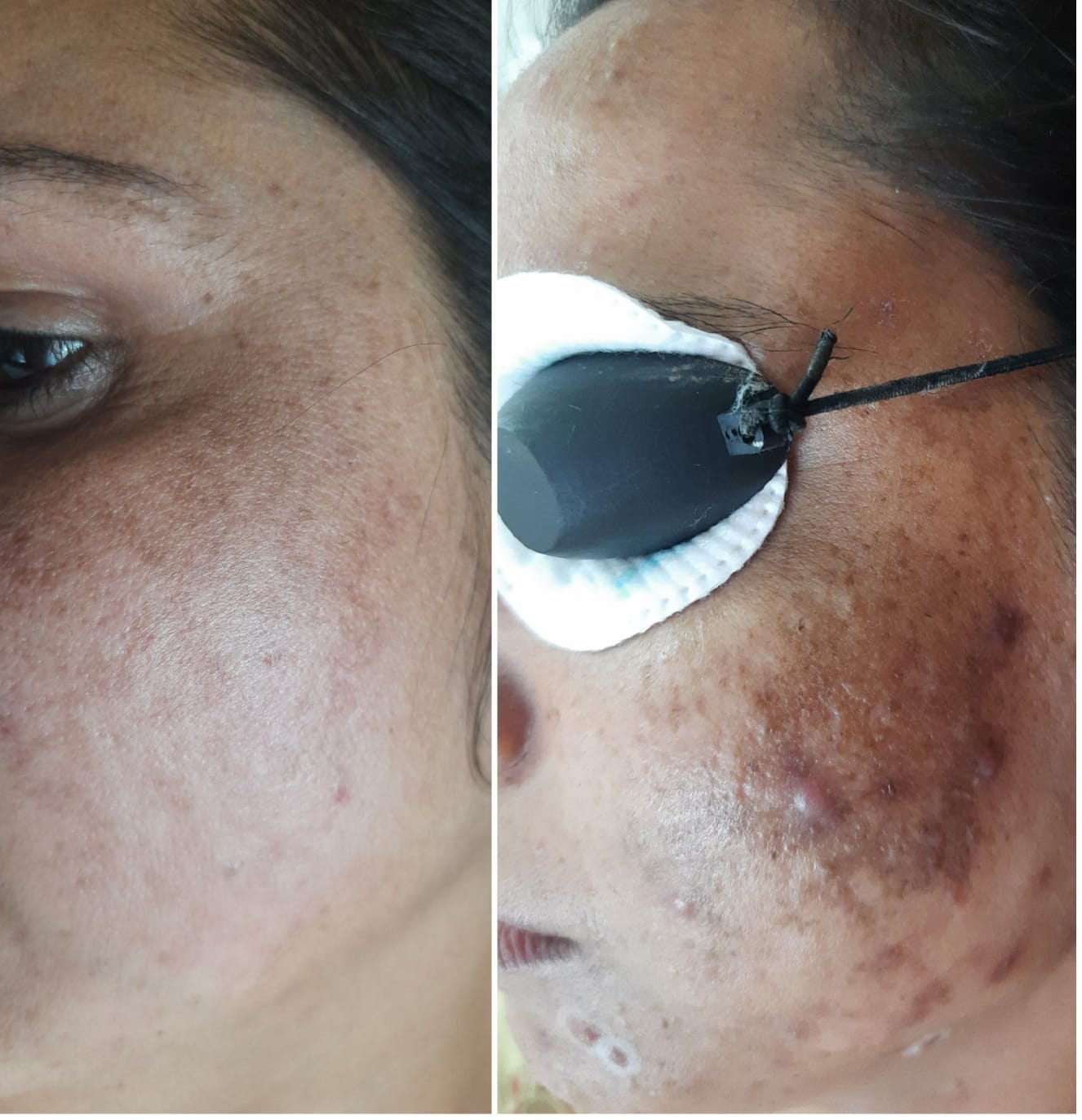
Clinical Background: A 38-year-old female patient residing in Kota presented to Skinssence Laser & Skincare Clinic in Talwandi, Kota with recalcitrant centrofacial and malar melasma of 5 years duration. Having experienced repeated pigment rebound, epidermal barrier thinning, and intense frustration from unmonitored over-the-counter hydroquinone and steroid-containing depigmentation creams, she sought an evidence-based, doctor-supervised clinical protocol to achieve sustainable clearance without triggering post-inflammatory hyperpigmentation (PIH).
Clinical Case Snapshot
- Patient Profile: 38-year-old female (Phototype IV)
- Primary Concern: Recalcitrant epidermal and dermal mixed melasma (Malar and Centrofacial patterns)
- Supervising Physician: Dr. Ashima Madan (MBBS, MD, FAM – DJPIMAC, Mumbai)
- Clinical Modality: Low-Fluence Q-Switched Nd:YAG Laser Toning (Sub-cellular Selective Photothermolysis)
- Clinic Location: Skinssence Laser & Skincare Clinic, Talwandi, Kota
Understanding the Pathology: Chronic Melasma & Melanocyte Hyper-Reactivity
Melasma is not merely a superficial pigmentary blemish; it is a complex, photo-induced neuro-vascular and hormonal dermatosis characterized by chronically hyperactive melanocytes, basement membrane disruption, altered dermal elastosis, and increased mast cell infiltration. In Kota's intense sunlight conditions, ultraviolet (UVA/UVB) and high-energy visible (HEV) blue light stimulate continuous tyrosinase expression.
Because melanocytes in Indian skin (Fitzpatrick Types III–V) possess heightened inflammatory reactivity, aggressive thermal treatments (such as high-energy fractional lasers or harsh deep peels) frequently aggravate melanogenesis, producing severe rebound hyperpigmentation. Sustainable clinical control mandates low-fluence, sub-photothermal laser toning designed to fragment dendritic melanosomes without killing melanocytes or injuring the basal membrane.
Doctor-Supervised Clinical Assessment & Wood's Lamp Examination
A rigorous examination by Aesthetic Physician Dr. Ashima Madan established the exact depth and vascular profile of the pigmentation:
- Wood's Lamp & Polarized Dermoscopy: Identified mixed epidermal-dermal melasma with prominent pseudonetwork hyperpigmentation and underlying telangiectatic micro-vessels.
- Cutaneous Barrier Integrity: Moderate baseline epidermal barrier compromise and erythema resulting from prior steroid-induced skin thinning.
- Realistic Clinical Goal-Setting: Dr. Ashima Madan conducted comprehensive counseling, setting the clinical expectation that melasma is a chronic, manageable biological tendency requiring gradual control and diligent lifelong photoprotection rather than a quick cure.
Why Low-Fluence Q-Switched Nd:YAG Laser Was Chosen
Rather than administering rapid, high-fluence passes that overheat tissue, Dr. Ashima Madan selected a conservative, sub-cellular selective photothermolysis protocol using a 1064 nm Q-Switched Nd:YAG laser. The 1064 nm wavelength penetrates deep into the reticular dermis with minimal melanin absorption in the upper epidermis, allowing targeted fragmentation of dermal melanophages while keeping the epidermis cool and structurally intact.
Dr. Ashima Madan's Customized 8-Session Treatment Protocol
The structured 8-session clinical journey was administered with meticulous medical oversight:
- Phase 1 – Barrier Rehabilitation (Weeks 1–2): Prior to laser initiation, the patient's compromised skin barrier was strengthened using topical ceramide formulations, niacinamide, and broad-spectrum mineral zinc oxide photoprotection.
- Phase 2 – Conservative Laser Toning (Sessions 1–3): Spaced at 2-week intervals using large spot sizes (7–8 mm) and ultra-low fluences (sub-erythemal dose) to test tissue reactivity and avoid heat accumulation.
- Phase 3 – Targeted Consolidation (Sessions 4–8): Progressive dual-pass toning spaced 3 to 4 weeks apart. Visible fading of mottled borders and evening of skin tone emerged decisively around Session 4.
- Phase 4 – Synergistic Maintenance: Incorporation of gentle tranexamic acid, azelaic acid, and antioxidant vitamin C serums between laser sessions to suppress melanin transfer without irritation.
Post-Treatment Clinical Advice & Long-Term Maintenance
To sustain long-term clarity and mitigate the natural tendency of melasma to recur under sunlight, structured guidance included:
- Non-negotiable daily application of broad-spectrum tinted mineral SPF 50+ sunscreen with iron oxides (protecting against both UV and HEV visible blue light), reapplied every 3 hours.
- Strict avoidance of hot facial steam, cooking vapor exposure without protection, and abrasive exfoliants.
- Adherence to prescribed medical skincare and barrier-supportive lipid creams.
- Scheduled quarterly clinical follow-up evaluations at our Talwandi clinic.
Clinical Outcome & Observations
Following eight controlled Q-Switched Nd:YAG laser toning sessions, the patient achieved a remarkable, progressive reduction in the Melasma Area and Severity Index (MASI), with marked clearance of both malar patches and restoration of an even, luminous complexion. Furthermore, the absence of rebound erythema or hypopigmentation confirmed the safety of the low-fluence approach.
At Skinssence Laser & Skincare Clinic, melasma treatment is conducted with patient safety, clinical diagnosis, and evidence-based rigor right here in Kota. Explore more successful transformations on our Clinical Case Studies hub or book a consultation with Dr. Ashima Madan today.
