
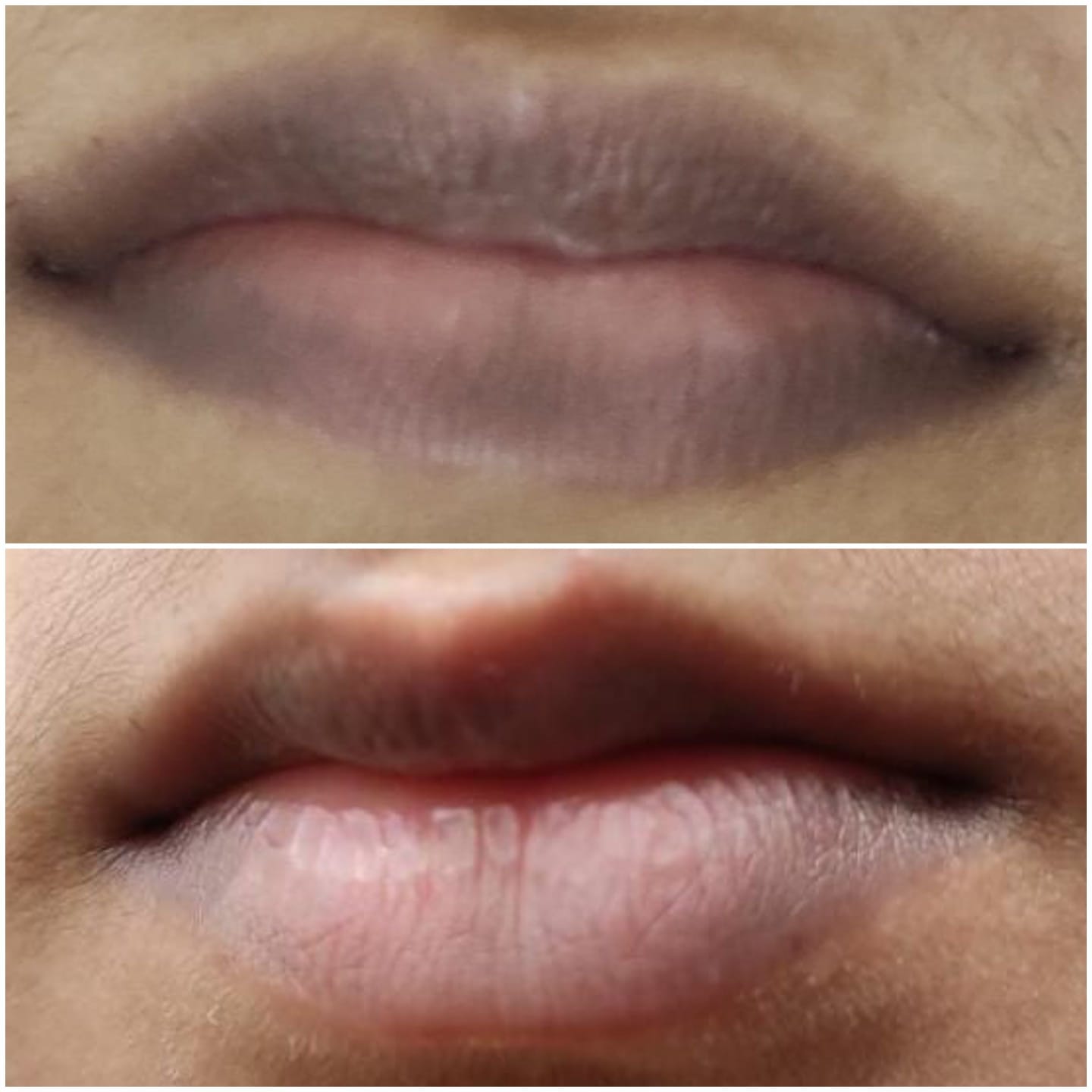
Clinical Background: A young adult male patient visited Skinssence Laser & Skincare Clinic in Talwandi, Kota while preparing for his upcoming wedding celebrations. With an established timeline before wedding photography and social functions, the patient sought a medical, non-invasive solution to alleviate persistent, noticeable labial hyperpigmentation associated with chronic cigarette smoking.
Clinical Case Snapshot
- Patient Profile: Young adult male (Groom-to-be)
- Primary Concern: Smoker's melanosis (diffuse dark hyperpigmentation of upper and lower vermilion borders)
- Supervising Physician: Dr. Ashima Madan (MBBS, MD, FAM – DJPIMAC, Mumbai)
- Clinical Modality: Q-Switched Nd:YAG Laser (532 nm / 1064 nm) Selective Photo-Thermolysis
- Clinic Location: Skinssence Laser & Skincare Clinic, Talwandi, Kota
Understanding the Pathology: Smoker's Melanosis & Labial Pigment Accumulation
Labial hyperpigmentation in chronic smokers arises from a combination of chemical stimulation and direct thermal radiation. Nicotine, tar, and combustion polycyclic hydrocarbons stimulate labial melanocytes to synthesize melanin via endothelin-1 up-regulation, while localized heat repeatedly dehydrates delicate vermilion tissue. Over years, this melanin deposits deeply into basal keratinocytes and the superficial mucosal lamina propria.
Because mucosal and vermilion skin lacks follicular sebaceous structures and possesses a thin, highly vascularized epithelium, salon lip-bleaches, abrasive scrubs, or harsh chemical agents carry catastrophic risks of chemical burns, post-inflammatory hyperpigmentation (PIH), or permanent scarring. Safe clinical restoration demands nanosecond-pulsed laser photo-acoustic selective melanin disintegration under rigorous medical control.
Doctor-Supervised Clinical Assessment
During the initial clinical consultation, Dr. Ashima Madan conducted a thorough mucosal and vermilion evaluation:
- Diffuse, homogeneous dark-brown to blackish dyschromia involving both the upper and lower lip vermilion borders.
- Documented history of cigarette consumption with absence of active oral mucosal ulceration, leukoplakia, or suspicious verrucous lesions.
- Fitzpatrick Skin Type IV, necessitating low-fluence parameters with spot size optimization to protect dermal vascular networks.
- Pre-procedural counseling on behavioral cessation or substantial reduction of smoking to safeguard cellular clearance and prevent relapse.
Why Q-Switched Nd:YAG Laser Was Selected
At Skinssence Kota, every pigmentation case is addressed through precision optics. Rather than attempting superficial acid peels on fragile lips, Dr. Ashima Madan selected the Q-Switched Nd:YAG laser system. Delivering pulses in nanosecond durations (5–10 ns), the acoustic shockwave mechanically shatters intracellular melanosomes into microscopic dust without generating continuous heat that could injure the surrounding labial capillary plexus.
Dr. Ashima Madan's Customized Labial Laser Protocol
The procedure followed a doctor-supervised, staged protocol spaced 4 to 5 weeks apart:
- Step 1 – Photographic Mapping & Topical Anesthesia: High-resolution standardized polarized cross-lighting photography, followed by 20 minutes of topical lidocaine/prilocaine occlusive cream for total procedural comfort.
- Step 2 – Laser Delivery & Real-Time Endpoint Assessment: Administering low-fluence Q-Switched Nd:YAG passes. The clinical endpoint was immediate subtle epidermal whitening (frosting), indicating precise photo-acoustic target fragmentation without bleeding or blister formation.
- Step 3 – Post-Laser Cooling & Barrier Locking: Application of physiological sterile thermal compresses followed by a soothing topical anti-inflammatory emulsion.
- Step 4 – Structured Treatment Cycle: An initial series of 3 scheduled sessions was planned ahead of the wedding timeline, providing adequate physiological clearance intervals for macrophage-mediated phagocytosis.
Post-Treatment Clinical Advice & Patient Home Care
To support rapid epithelial re-epithelialization and avoid post-treatment inflammation, the patient received clear medical directives:
- Apply prescribed topical antibiotic/anti-inflammatory ointment for 72 hours post-procedure.
- Avoid scalding hot beverages, citrus juices, spicy foods, and sour liquids for 4 days to eliminate chemical/thermal irritation.
- Maintain continual hydration with a medical-grade ceramide-rich SPF 30+ lip balm whenever exposed to sunlight.
- Crucial Lifestyle Directive: Abstain from smoking during the re-epithelialization window to prevent immediate re-staining of vulnerable mucosal tissue.
Clinical Outcome & Observations
Over the planned treatment cycle, macrophage clearance progressively cleared fragmented melanin granules. By session three, the patient demonstrated significant lightening: lips regained a healthy, natural pinkish hue with smooth, hydrated mucosal texture. The patient experienced a remarkable restoration of smile confidence for his wedding photography.
At Skinssence Laser & Skincare Clinic, lip pigmentation treatment is delivered with honest counseling, medical safety, and evidence-based clinical protocols right here in Kota. Explore more patient journeys on our Clinical Case Studies hub or book a consultation with Dr. Ashima Madan today.
