
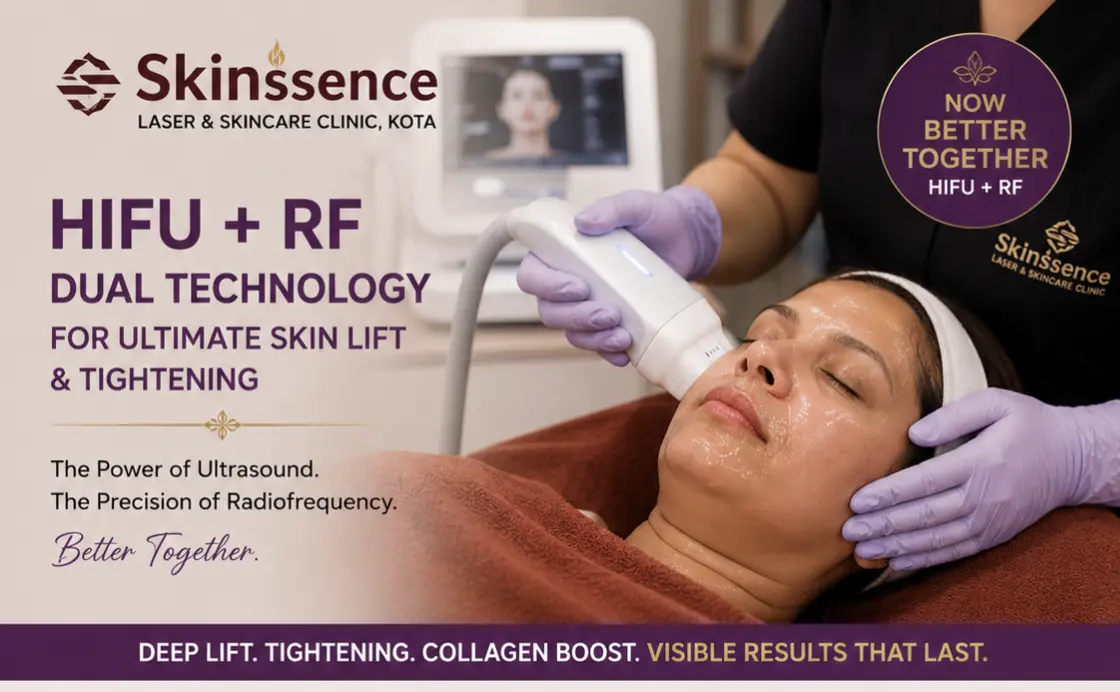
Sagging jawlines, softening cheeks, and the first signs of a "tired" profile usually show up in the mid-30s to 40s — well before most people are ready to consider surgery. HIFU (High-Intensity Focused Ultrasound) has become the most-asked-about option in Kota for exactly this stage: visible tightening, no cuts, no downtime, but the results build over months rather than appearing overnight.
This guide, from clinical practice at Skinssence Laser & Skincare Clinic in Talwandi, Kota, lays out the facts patients actually need before booking — how HIFU treatment in Kota works, what a realistic timeline looks like, who it suits, and where it fits next to other options like RF Microneedling and chemical peels.
HIFU compared with other skin-tightening and resurfacing options at Skinssence
| Treatment | Best for | Standout advantage | Downtime |
|---|---|---|---|
| HIFU | Mild-to-moderate jawline/neck laxity, early jowls, double chin | Reaches the deep SMAS layer without a single incision | None to minimal |
| Microneedling RF | Acne scars, open pores, surface texture | Combines micro-needling with targeted radiofrequency heat — see Microneedling in Kota | 24–48 hrs redness |
| Chemical Peel | Pigmentation, dullness, surface texture | Controlled-depth exfoliation and renewal — see chemical peels at Skinssence | 3–7 days peeling |
| HydraFacial | Hydration, congestion, pre-event glow | Painless vortex extraction with zero downtime — see HydraFacial in Kota | None |
These treatments are not competing options so much as tools for different layers of concern. A patient on a bridal skincare plan, for example, might combine HIFU months in advance for structural tightening with HydraFacial sessions closer to the date for surface glow. Dr. Ashima Madan sequences these at consultation rather than treating each in isolation.
The 10 facts patients should know before booking HIFU in Kota
1. HIFU reaches deep tissue without ever breaking the skin
It skips the surface entirely and heats targeted depths underneath.
Surface lasers and peels work on top of the skin. HIFU passes straight through to precise depths — commonly 1.5mm, 3.0mm, and 4.5mm — with that deepest layer corresponding to the Superficial Muscular Aponeurotic System (SMAS), the same structural layer surgeons address in an open facelift. Heating this zone to a controlled thermal point starts a natural repair and collagen-building response without any incision.
2. The visible lift is a slow build, not an instant result
The real change develops over the following months, not the following days.
A mild firming sensation right after treatment comes from heat reaction and temporary swelling — it is not the final result. New collagen production typically peaks between 60 and 90 days post-procedure, which is when the jawline and profile look their firmest. Patients expecting an immediate transformation are usually the ones disappointed; patients who understand the timeline in advance are not.
3. Most patients need only one or two core sessions
Results from a single session typically hold for 12–18 months.
A standard plan is one primary session. Patients with more advanced laxity sometimes benefit from a second session around three months later, followed by an annual maintenance touch-up to keep collagen turnover active as natural ageing continues.
4. HIFU and Microneedling RF solve different problems
One lifts structure, the other refines surface texture.
HIFU targets the deep SMAS layer for jawline and neck firming. Microneedling RF works at the dermis and surface level, smoothing acne scars, shrinking pores, and refining texture. Patients with both concerns — early sagging and scarring or texture issues — are often planned for both treatments on a staggered schedule rather than either alone.
5. It works best for mild-to-moderate laxity, not advanced sagging
HIFU tightens loose tissue — it cannot remove excess skin.
The best candidates are typically in their 30s to late 50s with early jowls, a mildly soft jawline, or slight neck laxity. Where skin laxity is severe, with visibly hanging folds, ultrasound energy alone will not pull tissue back far enough for a dramatic change, and a different plan should be discussed at consultation.
6. Your own biology drives the collagen response
The device delivers the signal — your body does the building.
HIFU results depend on the patient's own healing capacity. Smoking, high sugar intake, poor sleep, and heavy unprotected sun exposure all slow collagen synthesis and blunt the result. Adequate hydration and general nutritional support after treatment help the body complete the process it has been signalled to start.
7. It is a non-surgical alternative — not a substitute for surgery
HIFU tightens existing tissue; surgery repositions it.
A surgical facelift physically cuts and repositions loose tissue at a degree HIFU cannot replicate. HIFU is best understood as tightening what is already there through your own collagen response, which is why candidate selection (Fact 5) matters so much to satisfaction.
8. Practitioner skill and device quality directly affect safety
Depth accuracy is what keeps a HIFU session safe.
Ultrasound energy must be delivered at precise depths. Energy fired too close to the surface risks burns; energy placed over nerve pathways can cause temporary numbness. Medical-grade, correctly calibrated equipment and an experienced practitioner are what prevent both — this is a device- and skill-dependent treatment, not a one-size-fits-all setting.
9. Certain conditions rule HIFU out, at least temporarily
A basic safety screen comes before any session is booked.
HIFU should be postponed or avoided with: pregnancy or active breastfeeding; open wounds, severe active acne, or skin infection in the treatment area; metallic implants, pacemakers, or stents in the face or neck; or skin laxity advanced enough to require surgical removal rather than tightening. These are screened at consultation before any session is scheduled.
10. Sun protection after treatment protects the result you paid for
Unprotected UV exposure works against the collagen you just triggered.
Newly forming collagen fibres are more sensitive to UV damage. Daily broad-spectrum SPF 30+, and avoiding saunas, heavy sweating, or direct sun exposure for 48 hours post-treatment, protects the investment during the window when the skin is doing its most important repair work.
"The patients who are happiest with HIFU are the ones who came in for the right reason — early jowling or a softening jawline they want to firm up before it progresses further — and who understood from the first consultation that this is a three-month process, not a same-day one. We do a full facial assessment before every HIFU session, because the honest answer for some patients is that a different treatment, or a combination, will actually get them a better result."
— Dr. Ashima Madan (MBBS, MD, FAM – DJPIMAC, Mumbai), Skinssence Laser & Skincare Clinic, KotaChoosing between HIFU and other treatments at Skinssence
Main concern?
 ├── Mild sagging, early jowls, double chin?   → HIFU
 ├── Open pores, acne scars, rough texture?    → Microneedling RF
 ├── Pigmentation, dullness, dark spots?       → Chemical Peel / see also
 │                                                melasma & pigmentation treatment
 └── Dehydrated, congested, pre-event glow?    → HydraFacial
Many plans combine more than one branch — HIFU for structural tightening earlier in a treatment course, paired with maintenance HydraFacial sessions or a chemical peel course for surface concerns running alongside it. This is planned individually at consultation, not templated.
Where Skinssence fits
Skinssence provides HIFU treatment in Kota using medical-grade ultrasound equipment with precise depth-calibrated cartridges. Every plan begins with an assessment of facial structure, skin thickness, and laxity level by Dr. Ashima Madan, so the protocol — and whether HIFU is even the right primary treatment — is decided on your skin, not assumed in advance. For local availability, timing, and current session pricing, see the HIFU skin tightening page for Kota patients.
Frequently asked questions about HIFU treatment in Kota
Is HIFU treatment painful?
Most patients feel minor prickling or brief warm pulses beneath the skin only while the device is actively firing — the sensation stops as soon as energy delivery pauses. Intensity can be adjusted, and topical numbing is available for patients who want a more comfortable session throughout.
How much does HIFU treatment cost in Kota?
Session pricing depends on the area treated (full face, lower jaw, or neck) and the depth cartridges used. Exact current pricing at Skinssence is confirmed at consultation — see the HIFU Kota page for up-to-date session details.
How long do HIFU results last?
Most patients see results holding for 12–18 months, depending on age, skin quality, and daily habits such as sun exposure and smoking. Because natural ageing continues, an annual maintenance session is the standard way to hold on to the firming gained.
Is one HIFU session enough?
For most patients with mild-to-moderate laxity, one session produces noticeable tightening over the following two to three months. Patients with more advanced sagging sometimes benefit from a second session roughly three months after the first.
Can HIFU reduce a double chin?
Yes — HIFU is commonly used for submental (double chin) tightening. Specific depth cartridges focus heat into the fat and tissue beneath the chin, firming the surrounding skin and helping define the jawline over the following months.
Who should avoid HIFU treatment?
HIFU should be postponed or avoided in pregnancy or breastfeeding, over open wounds or active skin infection, in patients with metallic implants, pacemakers, or stents in the face or neck, and in cases of advanced skin laxity that need surgical correction rather than tightening. A safety screen at consultation confirms candidacy before any session is booked.
Clinic hours: Mon–Sat 11:00 am – 1:30 pm & 4:00 pm – 7:30 pm | Sunday 11:00 am – 1:30 pm
