
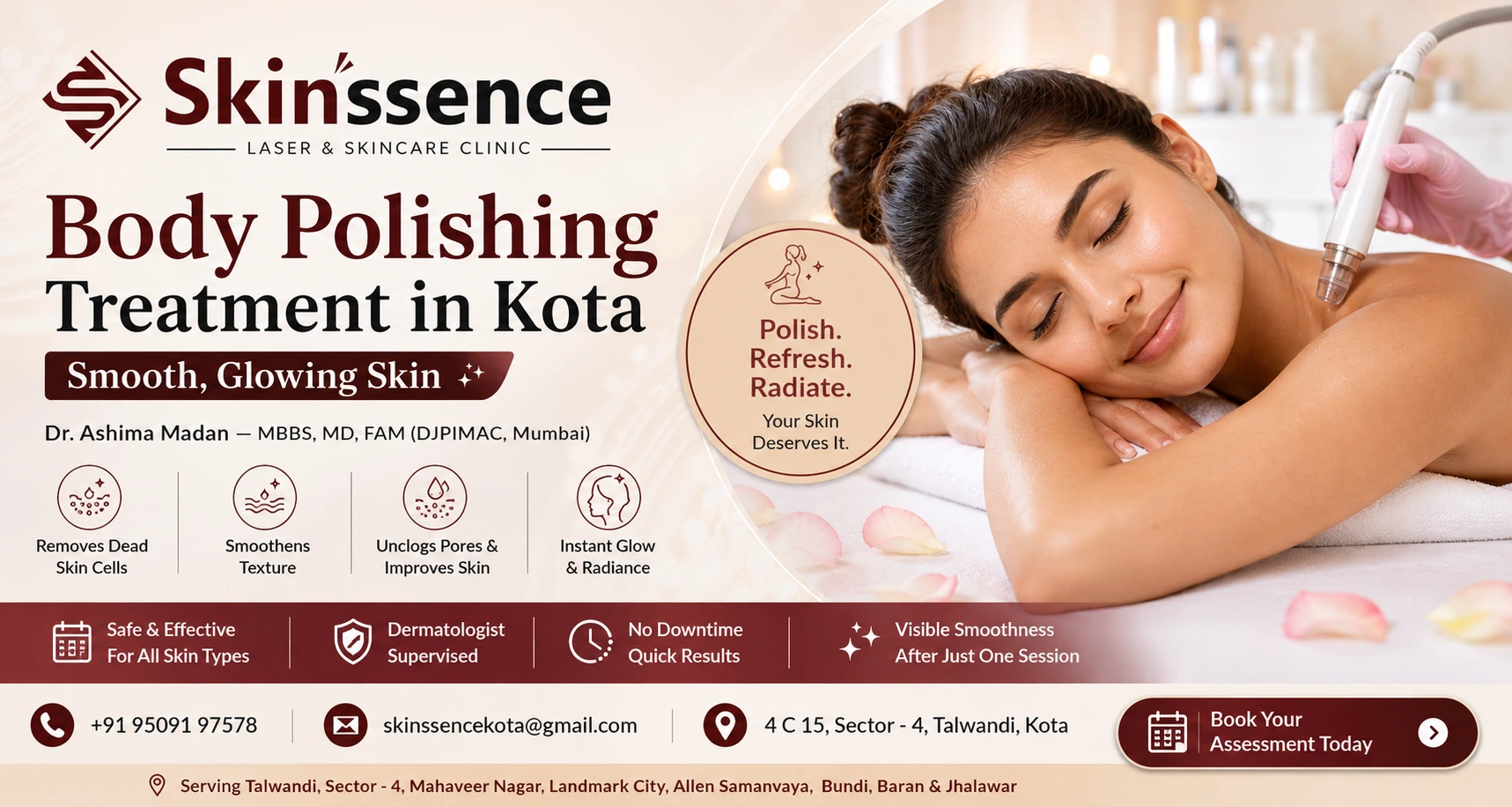
Body Polishing Treatment in Kota – Smooth, Glowing Skin
Body Polishing Treatment in Kota
— Should You Even Do It?
Most patients arrive asking for "glow." What they actually need depends entirely on what is sitting on their skin — and what is not. Here is how I decide before every session at Skinssence, Talwandi.
Seen commonly in Kota OPD: tanning, rough texture, and "dull skin" concerns from daily sun exposure and dust.
Book Assessment →Before booking a session at Skinssence, read this. It is written the way I explain things in clinic — not the way a product page would.
Most patients who come in have already tried scrubs and home remedies for months. What changes here is not just the skin — it is finally seeing the skin respond correctly.
Should You Do Body Polishing? — 30-Second Decision Guide
The most important question is not "what does body polishing do?" — it is "will it do anything for your specific concern?" Here is the filter I apply in the OPD before planning any session.
Your concern → What I actually recommend
Based on clinical outcomes at Skinssence, Kota — not generalised treatment descriptions
| Your concern | Will body polishing work? | What I suggest |
|---|---|---|
| Dull, rough surface skin | Yes — primary use | Monthly polishing course |
| Tanning from daily exposure | Partial | Polishing + laser skin toning for deeper tan |
| Clogged pores, surface congestion | Yes | Polishing, possibly combine with medi facial |
| Pre-wedding or event glow (3–5 days prior) | Yes | Ideal timing; may combine with HydraFacial if dehydrated |
| Deep or hormonal pigmentation / melasma | No | Melasma treatment — polishing may worsen |
| Active acne on body | No | Medical acne treatment first |
| Stretch marks or deep scars | No | Dedicated stretch mark treatment |
| Wanting overall skin brightness or pigmentation correction | No | Requires evaluation — may involve internal support (like glutathione), topical protocols, or laser-based treatments depending on cause |
What Body Polishing Actually Does — and the Layer It Cannot Reach
Body polishing is a surface exfoliation treatment. The diamond-tip microdermabrasion device moves across the skin in controlled passes, removing the superficial dead cell layer while suction clears the debris simultaneously. It works at the epidermal surface — not at the dermal level where pigmentation, hormonal discolouration, and post-inflammatory marks actually sit.
When expectations match this mechanism, patients are satisfied. When they do not — when someone comes expecting deep whitening or scar reduction — the session feels like it "didn't work." It worked exactly as it should; the indication was simply wrong.
What body polishing cannot do
- It does not change your base skin colour
- It does not treat melasma or hormonal pigmentation
- It does not remove deep pigmentation
- It does not improve stretch marks or deep scars
- It does not provide permanent tanning removal
| Concern | Body polishing effective? | Better option if not |
|---|---|---|
| Dull, rough surface skin | Yes — primary use | — |
| Clogged pores and surface congestion | Yes — clears surface blockage | — |
| Uneven surface texture | Yes — improves across sessions | — |
| Surface tanning | Partial — removes existing surface tan only | Laser skin toning for deeper or persistent tan |
| Pre-event glow | Yes — safe 3–5 days before event | HydraFacial if skin also needs deep hydration |
| Active acne on body | No — spreads inflammation | Medical acne treatment first |
| Deep or hormonal pigmentation, melasma | No — may worsen sensitised skin | Melasma and pigmentation treatment |
| Deep acne scars or stretch marks | No — surface only | Stretch mark treatment |
What makes body polishing at Skinssence different
At Skinssence, body polishing is not performed using fixed machine settings or a standardised protocol. I adjust suction pressure, number of passes, and coverage based on the patient's skin thickness, UV exposure pattern, and pigmentation risk.
In Kota patients especially, over-treatment is a real risk. My approach is deliberately conservative — I would rather under-treat in one session and build results safely than trigger irritation and pigmentation by overdoing it.
Why Kota Skin Responds the Way It Does
Kota's UV exposure and dry heat create a specific pattern I see every week: uneven tanning on arms, neck, and back; rough texture from the cycle of sweating and dust; and dullness that home creams cannot fix because the dead cell layer on top is not being removed. Coaching students and working patients who commute daily accumulate this surface damage faster than they can manage at home.
For this pattern — surface roughness, mild accumulated tanning, congested texture — body polishing is genuinely useful. What patients describe as "glow" is exactly this: cleaner, smoother skin reflecting light uniformly rather than diffusely through a layer of dead cells and debris.
What it does not reach is the dermal layer where years of UV damage, hormonal pigmentation, and post-inflammatory marks sit. That requires a different protocol — and I explain this during consultation, not after three sessions of polishing that produced no pigmentation improvement.
How Different Kota Patients Actually Respond — From the OPD
These are the patient profiles I see most often at Skinssence. The responses described are consistent patterns from actual clinic experience — not averages from a trial.
? Coaching students (18–25)
Daily outdoor exposure, sweat and dust accumulation, minimal skincare routine
What I see:
- Fast improvement in surface texture
- Visible glow usually apparent after 1–2 sessions
- Results hold well if sunscreen is used consistently — which at this age, it often is not
- Best outcome when combined with a basic home routine post-session
? Working women (25–40)
Irregular care cycle, mix of tanning and dryness, occasionally melasma history
What I see:
- Good response, but requires 3–4 sessions for sustained improvement
- Results do not hold without sunscreen — this age group often has higher UV exposure and less consistent aftercare
- I screen carefully for melasma before starting; polishing on melasma-prone skin without prior assessment is a common avoidable mistake
? Pre-bridal patients
High expectations, time pressure, often want instant visible change
What I do:
- Schedule final polishing session 3–5 days before the event — not same-day
- For brides with dry or dehydrated skin, I combine with HydraFacial in the months before
- In the full bridal plan, polishing is the finishing and maintenance step — corrective work like peels and laser toning happens 3–6 months earlier
- I set the outcome expectation at the first consultation — not the day before the wedding
❌ Patients who should not be booked
These are the cases I redirect before any session is planned
- Active acne on body — polishing spreads inflammation and worsens breakouts
- Melasma or spreading pigmentation — surface exfoliation on sensitised melanocytes worsens the condition
- Over-exfoliated, barrier-damaged skin — adding more exfoliation to already irritated skin produces post-inflammatory pigmentation
- Patients expecting a skin colour change — if the expectation is a lighter base tone, this treatment cannot deliver it and I say so directly
What Actually Happens During a Session at Skinssence
Sessions take 30–45 minutes depending on the treatment area. After cleansing the skin, a diamond-tip microdermabrasion device is moved across the area in controlled passes. The pressure and number of passes are adjusted based on skin thickness, sensitivity, and the concern being addressed — not applied uniformly the way a home scrub would be.
How I modify the protocol — not a fixed machine setting
Body polishing is not a fixed protocol. The settings change with the patient sitting in front of me.
Most patients feel mild suction and a light scraping sensation — no pain. After the session, a soothing moisturiser and SPF are applied before leaving. The sunscreen step is not optional and not an afterthought — it is the last clinical step of every session.
A simple way I decide this in clinic
If removing the surface layer will solve your concern, I recommend body polishing. If the issue sits deeper — pigmentation, melasma, or scarring — I do not. That decision is made before the first session, not after multiple sessions fail.
Session-by-Session — What You Will Actually Notice
If you are expecting visible whitening after one session, this is not the right treatment. What you will notice is smoother skin, better reflectivity, and cleaner texture. Here is the realistic progression.
After Session 1
Skin feels noticeably smoother immediately. Slight brightness — the way skin looks after a thorough exfoliation, not dramatically lighter. Mild redness for a few hours is normal.
After Sessions 2–3 (3–4 weeks apart)
More even surface tone. Clogged pores visibly reduced. Surface texture starts showing lasting improvement rather than reverting between sessions. Patients who maintain sunscreen between sessions see the most difference at this stage.
After Sessions 4–6
Sustained smoothness. Substantially less rough texture. Accumulated surface tanning noticeably lighter on exposed areas. Skin holds the improvement between sessions rather than requiring the session to recover baseline.
Maintenance phase (monthly)
One session per month maintains what the initial course established. In Kota's UV environment, maintenance without consistent sunscreen is a losing battle — the sessions will keep reversing.
Why Body Polishing "Didn't Work" — The Four Patterns I See
In my experience, the cases where patients are unhappy almost always trace to one of four things — not the procedure itself. When a patient comes back saying "nothing happened" or "my skin looks worse," one of these is nearly always the explanation.
"I did 2 sessions, nothing happened"
What happened: The expectation was whitening or deep pigmentation correction — neither of which body polishing addresses. The procedure worked; the indication was wrong from the start.
"Glow lasted only 3–4 days"
What happened: No sunscreen after the session. Freshly polished skin in Kota's afternoon UV re-tans faster than untreated skin would. The result reversed before it could stabilise.
"Skin got darker after sessions"
What happened: Over-polishing or wrong indication — most commonly, sessions done on melasma-prone or sensitised skin. Any skin irritation on melanocyte-sensitised skin can worsen pigmentation. This is why a prior dermatologist assessment matters.
"I scrubbed at home to extend the glow"
What happened: Over-exfoliation at home on freshly polished skin damaged the newly exposed layer. Patchy irritation, increased sensitivity, and sometimes post-inflammatory marks followed.
The honest pattern
In most cases where patients feel body polishing failed, the procedure is not the variable that failed — the indication, frequency, or aftercare was. I make sure patients understand this before they leave, not when they return with a complaint.
In most cases, dissatisfaction is predictable before the first session — which is why indication matters more than the procedure itself.
When I Say No to Body Polishing
Overdoing this treatment is more harmful than not doing it. If I feel body polishing will not produce a visible, safe result for a specific patient, I advise against it — even if they came specifically for it. These are not edge cases; I redirect patients out of polishing and into the correct treatment on a regular basis.
Active acne on the body
Mechanical exfoliation spreads bacterial contamination across the treatment area. Any inflammation in the skin at the time of treatment disqualifies the session. I defer until acne is medically controlled first.
Melasma or spreading pigmentation
Even a surface procedure can trigger a worsening response in melanocyte-sensitised skin. Patients with a history of melasma need a formal assessment before any exfoliation is planned — not a booking.
Over-treated or barrier-damaged skin
Skin that is already sensitised from previous over-exfoliation, over-treated with home actives, or recovering from irritation is not a candidate. Adding more exfoliation to a compromised barrier is how post-inflammatory pigmentation develops.
Expectation of a skin colour change
If the stated goal is a lighter base skin colour, body polishing cannot deliver it and I say so in the first consultation. Patients who need melanin suppression are directed to Glutathione IV therapy or a dedicated pigmentation protocol instead.
Body Polishing vs HydraFacial — How I Choose
These are not alternatives to each other. In a planned maintenance programme, they serve different purposes at different stages. The decision depends on what your skin actually needs.
| Treatment | How it works | Primary result | I choose this when |
|---|---|---|---|
| Body polishing (microdermabrasion) |
Mechanical exfoliation via diamond-tip wand; removes dead cell layer | Smoother texture, surface glow, unclogged pores | Skin is rough; surface tanning; monthly body maintenance; pre-event body skin |
| HydraFacial | Vortex suction + active serum infusion simultaneously | Deep hydration, pore cleansing, immediate radiance with barrier support | Skin is dry or dehydrated; needs cleaning AND hydrating; pre-event facial glow |
In a complete maintenance plan, body polishing handles monthly surface upkeep while chemical peels address deeper texture and pigmentation at intervals. A dermatologist assessment determines the right sequence — these procedures complement each other at different stages, not compete.
Who Benefits from Body Polishing at Skinssence
Dull, rough skin — the most consistent use
Accumulated dead cells make skin look flat, feel rough, and reduce how well anything applied on top penetrates. A single session produces noticeable improvement. A course of 4–6 sessions spaced 3–4 weeks apart produces lasting texture change. This is the most straightforward use and where results are most predictable.
Pre-event preparation
One of the few treatments safe within a week of a function — no downtime, immediate surface brightness. Correct timing is 3–5 days before the event, not same day. In a bridal skincare plan, polishing is used as a finishing step throughout the months before the wedding, not as the primary corrective treatment.
Surface tanning on arms, back, and neck
Accumulated surface tan from daily commuting and outdoor exposure responds well over a course of sessions. Deeper or hormonal body pigmentation does not — this distinction matters and requires assessment before planning sessions.
Maintenance between deeper treatments
Patients going through a chemical peel or laser course use monthly polishing to maintain surface smoothness between sessions — keeping skin clear and even throughout rather than only after the full course is complete.
Improving skincare absorption
A dead cell layer reduces how effectively serums and moisturisers penetrate. Monthly polishing measurably improves the performance of whatever home routine is being used — sometimes recommended as a preparatory step before beginning a new active skincare plan.
Sensitive skin — with modified settings
Patients with sensitive skin can have polishing with lower pressure and fewer passes. Settings are assessed at the session. Patients with a history of reactions, active irritation, or inflamed skin are deferred until the skin has settled.
Why Results Hold or Reverse — The 48-Hour Window
Body polishing removes what is on the surface. What happens in the 24–48 hours after the session determines whether the skin stays clear or returns to baseline within the week.
The most common reason results do not hold in Kota patients: going into afternoon sun immediately after a session without sun protection. Freshly exfoliated skin is more UV-sensitive than untreated skin, and Kota's UV between noon and 4 PM re-tans exposed skin faster than the polishing removed the previous tan. Patients who say the result "only lasted 3–4 days" are usually describing exactly this — not a failed session, but an aftercare gap.
The second most common reason: over-scrubbing at home in the days after, assuming more exfoliation extends the glow. It does the opposite. It irritates the newly exposed skin, damages the barrier, and in darker skin tones creates patchy pigmentation from the irritation response.
Before your session
Avoid sun exposure, waxing, and harsh scrubs for one week prior. Arrive with clean skin. Inform Dr. Ashima Madan of any recent procedures, medications, or active skin conditions — including any prescription actives or isotretinoin.
After your session
SPF 30+ on treated areas immediately and every morning — non-negotiable. No exfoliants, scrubs, or retinoids for 48 hours. Avoid hot baths and steam for 24 hours. Mild redness for a few hours is normal and resolves on its own.
Questions Patients Ask About Body Polishing in Kota
What is body polishing and what does a session actually feel like?
Body polishing — clinically microdermabrasion — uses a diamond-tip wand to mechanically remove the superficial dead cell layer, with integrated suction clearing the exfoliated material simultaneously. During the session most patients feel mild suction and a light scraping sensation — not pain. Pressure and the number of passes are adjusted by Dr. Ashima Madan based on skin type, sensitivity, and concern — not applied uniformly.
After the session, skin feels smoother immediately and looks slightly brighter — comparable to how skin looks after a good exfoliation, not dramatically lighter. Lasting surface texture change accumulates across multiple sessions, not after one.
Is body polishing the same as a HydraFacial?
No — they address different things. Body polishing is mechanical exfoliation: it removes dead cells and clears surface congestion. HydraFacial combines suction with active serum infusion — it hydrates while it cleans. Body polishing is the right choice for rough texture and surface tanning; HydraFacial is the right choice when skin also needs deep hydration. In a bridal plan they are often used at different stages for different purposes — not as alternatives to each other.
How many sessions are needed, and how often?
A single session produces visible surface improvement. For lasting texture change and sustained reduction in mild tanning, 4–6 sessions is a realistic initial course. The correct interval between sessions is 3–4 weeks minimum — not weekly. Sessions too close together damage the skin barrier, increase sensitivity, and raise pigmentation risk. Monthly maintenance after the initial course sustains the result. For pre-event purposes, one session 3–5 days before the event is appropriate — same day is not recommended.
Can body polishing remove tanning permanently?
No. It removes existing surface tan. New tanning returns with ongoing UV exposure. Patients who maintain sunscreen on treated skin after sessions retain clearer skin significantly longer than those who do not. In Kota's UV environment — particularly the 12–4 PM window — sunscreen after polishing is not optional. It is what determines whether the session produces a result that lasts days or weeks.
Can I get body polishing done before a wedding?
Yes — 3–5 days before is the ideal timing. Close enough to have visibly fresher skin on the day, far enough for any mild redness to fully settle. Same-day polishing is not recommended. In a full bridal skincare plan, body polishing is used as a finishing and maintenance treatment throughout the months before the wedding — not as the main corrective procedure. The corrective work — peels, laser toning, pigmentation treatment — is completed in the earlier months.
Is body polishing safe for darker Indian skin tones?
Yes, with appropriate settings. Mechanical exfoliation does not interact with melanin the way acids and lasers do — it removes the dead cell surface without directly targeting pigment. The caution is with patients who have active or borderline pigmentation: any skin irritation on melanocyte-sensitised skin can worsen pigmentation even from a surface procedure. Patients with a history of melasma, spreading pigmentation, or skin that has reacted poorly to previous treatments should have a dermatologist assessment before booking — not after.
Is there any downtime after body polishing?
No downtime. Mild redness for a few hours is common and resolves on its own. Normal activity resumes the same day. The main aftercare requirements are sunscreen on treated areas immediately after the session, no harsh exfoliants or retinoids for 48 hours, and no hot baths or steam for 24 hours. In Kota's climate, sunscreen is the non-negotiable step — freshly polished skin in direct afternoon sun without protection reverses the session's benefit faster than most patients expect.
Can body polishing fix stretch marks or deep scars?
No. Body polishing works at the epidermal surface only. Stretch marks and deep scars are structural changes in the dermis — an entirely different skin layer that surface exfoliation cannot reach. Patients with stretch mark concerns are directed to dedicated stretch mark treatment, which uses different technology appropriate for that indication.
Book online → | Call / WhatsApp +91 95091 97578
Consult Dr. Ashima Madan (MBBS, MD, FAM – DJPIMAC, Mumbai)
Personalized, doctor-supervised treatment plans at Skinssence Laser and Skincare Clinic, Talwandi, Kota.