
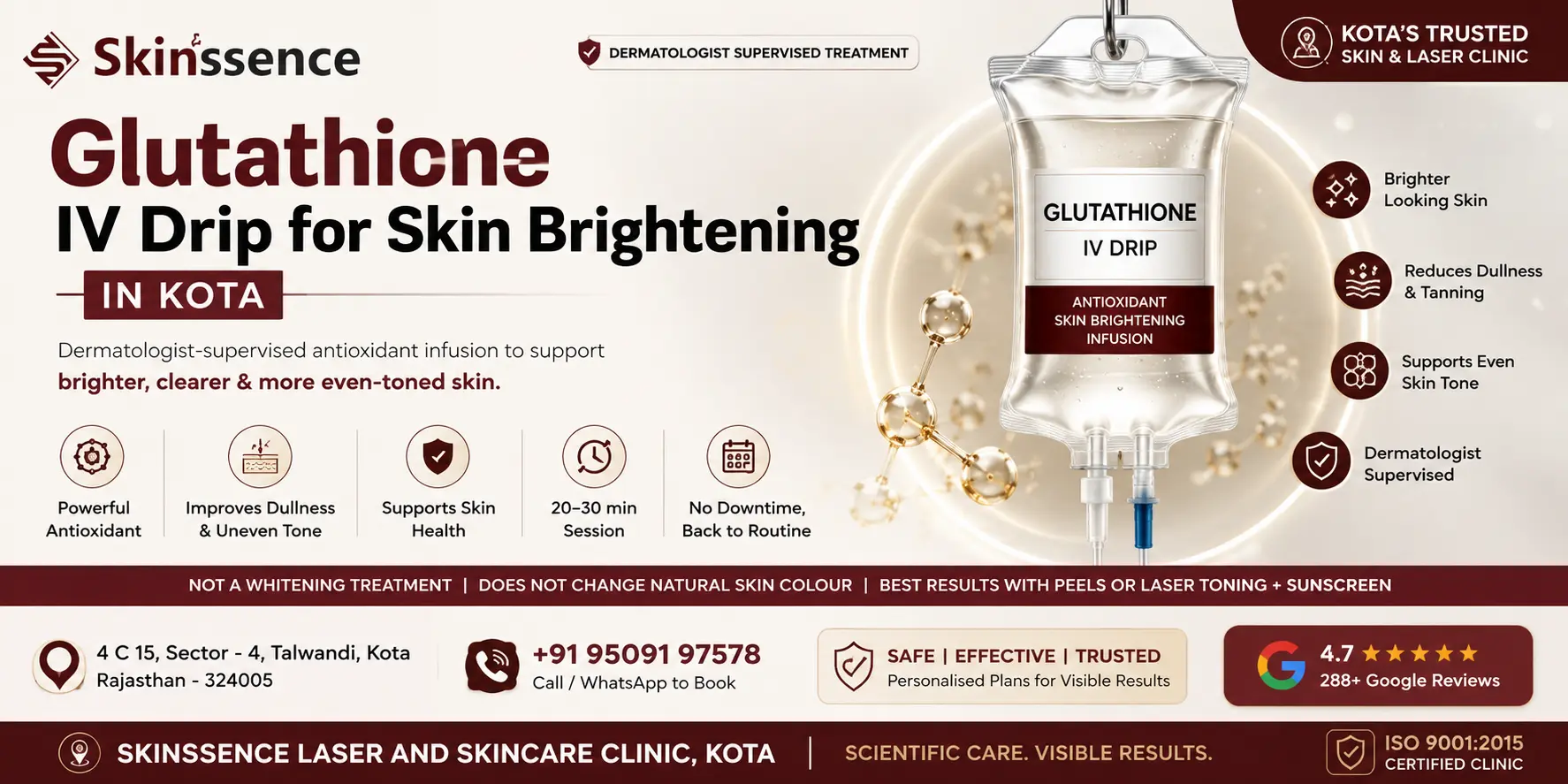
Glutathione IV Drip for Skin Brightening in Kota – Dr. Ashima Madan
Glutathione IV Drip in Kota — What It Actually Does, and Who It Is Actually For
Most patients who ask for a glutathione IV drip at Skinssence want one of three things: full body whitening, permanently fair skin, or visible change in one or two sessions. My first response is to clear this up — because if we do not align on what this treatment does before starting, it becomes one of the most disappointing procedures patients try in cosmetic dermatology.
Glutathione IV is a dermatologist-supervised antioxidant infusion. At the cellular level, it reduces oxidative stress and partially suppresses melanin synthesis. What patients see over time: skin that looks clearer, brighter, and more even — not lighter in base colour. It does not change your natural skin colour permanently. It does not remove melasma. It does not replace sunscreen, which does more for sustained skin brightness than any glutathione course can.
Used in the right patient — someone with dullness, accumulated tanning, or PCOD-related uneven tone who is already doing the basics correctly — it is genuinely useful. Whether that is you, and whether your money is better spent here or on something else first, is what the consultation at Skinssence is for.
Every session is planned and supervised by Dr. Ashima Madan (MBBS, MD, FAM – DJPIMAC, Mumbai), practising medical cosmetology in Kota since 2003. Dosage, session frequency, and combination plan are determined after a clinical assessment — not from a price list.
Should you start glutathione IV? — Quick decision guide
Before any session is booked at Skinssence, this is the kind of thinking that happens at consultation. It saves patients from spending on something that will not give them the result they are hoping for.
| Your situation | Glutathione IV appropriate? | What I actually suggest |
|---|---|---|
| Dull, tanned, or tired-looking skin despite basic skincare | Yes — good candidate | 4–6 session course; combination with peels if tanning is the main concern |
| Overall uneven tone, not a specific spot or scar | Yes — supportive | Works best alongside laser toning or peels; standalone is slower |
| Melasma — spreading facial pigmentation | Partial only | Melasma treatment first; glutathione added after stabilisation as maintenance support |
| Post-acne marks and dark spots | Partial only | Chemical peel or laser toning is more effective; glutathione added if tanning also present |
| Primary goal is fairness — lighter base skin colour | No | This treatment does not deliver that; wrong fit regardless of sessions or dosage |
| Wedding in 2 weeks | No — too late | HydraFacial or medical facial for surface glow; glutathione needs 2–3 months to show |
| Budget is limited | Defer | Peels and sunscreen correction first; glutathione added when core treatments are in place |
| Dull skin + PCOD or hormonal pigmentation | Yes — good combination candidate | Alongside PCOD skin management; reduces melanin reactivation between hormonal cycles |
What result you will see depends on your starting point — Kota patient patterns
In my years practising in Kota, certain patient types show up repeatedly for this treatment. What each of them realistically sees from a glutathione course is different — and knowing which type you are is more useful than a generic "results vary" disclaimer.
Coaching-belt students, 18–25 years
Kota's coaching population — daily outdoor commuting, summer exposure, irregular meals and sleep — accumulates surface dullness fast. This group responds fastest to glutathione IV because UV damage is relatively recent, skin cell turnover is high, and the antioxidant effect translates quickly to visible surface glow. Combined with a 3–4 session peel course, results are often visible by session 3.
Working women, 28–42 years
Stress, irregular sleep, commuting in summer heat, and often PCOD-related hormonal fluctuation all actively deplete glutathione between sessions. This group needs the combination approach to see meaningful change — glutathione alone at 4–6 sessions typically produces modest brightening. When combined with laser toning and a structured pigmentation plan, the results are more visible and hold better.
Bridal patients starting 2–3 months out
This is one of the highest-value uses at Skinssence. Glutathione IV running alongside peels or laser toning over 8–10 weeks produces visible, cumulative brightness improvement that holds through the pre-wedding period. The skin looks consistently better at each pre-wedding function — not just on the last day. Starting close to the wedding produces more cost than result.
Patients expecting fairness
This is the most common mismatch I see in Kota. The desire for lighter base skin colour is real and understandable — but glutathione IV does not deliver this, regardless of dosage or number of sessions. Any clinic claiming permanent fairness from glutathione IV is overstating the treatment. I tell this to patients directly at consultation rather than taking sessions and disappointing them later.
45+ years without combination treatment
At this stage, glutathione as a standalone brightening treatment produces limited visible change. The antioxidant support benefit is real — but the visible skin brightening patients are hoping for requires a combination approach. If visible improvement is the goal, peels, laser toning, or HydraFacial are more effective first steps. Glutathione works better as an add-on than the primary treatment.
PCOD-related dullness and uneven tone
Hormonal fluctuation in PCOD continuously drives melanin production — which is why results from peels and laser toning reverse faster in this group than in patients without the hormonal component. Glutathione IV alongside the primary PCOD skin management plan helps slow that reactivation cycle. It does not replace treatment of the hormonal root cause, but it supports the skin between treatment sessions.
Why most glutathione treatments in Kota do not produce the expected results
The actual reasons — from what I see at Skinssence
Patients who come to me after disappointing results from glutathione IV done elsewhere almost always trace the problem to one of these. This is not a criticism of the treatment itself — it is a consistent pattern of how the treatment is commonly misused.
- No sunscreen, or sunscreen applied once and not reapplied: The most common reason. Melanin suppression from glutathione is continuously reversed by UV exposure. In Kota's summer, even 20 minutes of unprotected outdoor exposure between sessions undoes more than a session can achieve. SPF is not an aftercare suggestion — it is a clinical requirement for this treatment to work.
- Sessions stopped after 2–3: The early sessions establish the antioxidant environment. Visible change comes from sessions 3–6 onward. Patients who stop at session 2 because "nothing is happening yet" are stopping just before the treatment starts producing what they came for.
- Treating glutathione as a replacement for the right treatment: Using it instead of melasma treatment, instead of a peel course, or instead of acne management. Glutathione supports a plan that is already working — it does not replace the plan. This is the most expensive version of the mistake.
- Fixed-dose packages at non-clinical clinics: The same dose applied to every patient regardless of skin type, weight, or concern. At Skinssence, dosage is calibrated after clinical assessment. A standard dose from a package is not a medical plan — it is a product sold at volume.
- Kota-specific: expecting summer results without heat avoidance: Patients going through a glutathione course in April–June without adjusting for heat exposure are fighting the treatment with their lifestyle. Heat independently stimulates melanocytes. I adjust session planning and combination therapy for Kota's seasonal UV cycle specifically because of this.
What glutathione IV achieves — and what requires a different treatment
| Concern | Glutathione IV useful? | Realistic expectation |
|---|---|---|
| Dullness and lack of overall glow | Yes — primary indication | Gradual visible improvement from session 2–3; skin looks clearer, not lighter in base colour |
| Surface tanning and accumulated sun damage | Yes — supportive | Faster when combined with laser skin toning; standalone improvement is slower |
| Uneven skin tone and patchy clarity | Yes | Consistent SPF essential — results reverse rapidly without it in Kota's UV environment |
| Mild to moderate pigmentation | Partial only | Significantly better when combined with pigmentation treatment or chemical peel |
| Melasma | Supportive only | Cannot treat melasma alone; reduces melanin reactivation after proper melasma management |
| PCOD-related dullness and uneven tone | Yes — alongside PCOD skin plan | Slows melanin reactivation between hormonal cycles; works alongside, not instead of, PCOD treatment |
| Oxidative stress and early skin ageing | Yes | Long-term antioxidant support; more relevant as maintenance than as corrective treatment |
| Deep acne scars or textured scarring | No | MNRF or dedicated scar treatment needed — glutathione does not change scar texture |
| Permanent skin colour change or fairness | No — not what this treatment does | Results are maintenance-dependent and reverse when sunscreen and sessions stop |
IV vs oral supplements vs topical glutathione — what the difference actually is
This question comes up in almost every consultation. Patients usually come having already tried supplements or glutathione face washes — which is usually why they are considering IV.
Oral glutathione supplements have poor bioavailability — a significant portion is broken down in the gut before reaching systemic circulation. They are not useless for general antioxidant support, but the effective concentration reaching skin cells is much lower than IV. Most patients I see who tried oral supplements for 2–3 months noticed little visible change — which is what typically brings them to the clinic.
Topical glutathione — face washes, creams, serums — does not absorb through the skin in clinically meaningful amounts. The skin barrier is designed to keep things out. Face wash contact time is measured in seconds. This is not a product quality issue; it is how skin physiology works. Topical glutathione products are a marketing category, not a clinical delivery route.
IV glutathione bypasses the digestive tract entirely, delivering concentrated antioxidant directly into systemic circulation. Onset is faster and the effective dose is more consistent and controllable. This is why IV delivery is the route used in a clinical dermatology plan — and why it requires medical supervision, calibrated dosage, and multiple sessions to produce what it promises.
How glutathione IV at Skinssence differs from a drip clinic or salon package
| What you are comparing | Standalone drip clinic / salon package | Skinssence, Kota — Dr. Ashima Madan |
|---|---|---|
| Who assesses suitability | Typically not assessed — purchase and book | Clinical evaluation by dermatologist before first session; some patients redirected to a different treatment |
| Dosage | Fixed package dose applied uniformly | Calibrated based on body weight, concern, and combination plan at each assessment |
| Who administers the infusion | Often a technician in a non-medical setting | Supervised by Dr. Ashima Madan in a clinical setting with sterile single-use equipment |
| What happens if you are the wrong candidate | Treatment is sold regardless | Consultation redirects to the right treatment instead |
| Combination planning | Sold as standalone product | Integrated into a broader plan — peel, laser toning, or PCOD management — where that produces better outcomes |
| Expectation setting | Often marketed as whitening or fairness | Clarified at consultation — not a whitening treatment; not permanent; not a replacement for sunscreen |
When combination treatment produces clearly better results
Glutathione IV + Chemical peel — for tanning and surface pigmentation
The peel removes accumulated surface pigment. Glutathione reduces the rate at which melanin is resynthesised underneath. Together they address the existing deposit and the mechanism producing it — which is why this pairing produces faster visible improvement than either alone. Glutathione also reduces the post-peel rebound pigmentation that is the most common reason peel results do not hold in Indian skin.
- Peel removes surface pigment; glutathione slows how quickly new melanin replaces it
- Most relevant for Kota patients with accumulated UV tanning from daily outdoor exposure
- Combined course typically shorter than running either treatment sequentially
Glutathione IV + Laser skin toning — for deeper pigmentation and sustained brightness
Laser toning fragments melanin deposits in the deeper dermal layers. Glutathione reduces how quickly that melanin is resynthesised between sessions. The visible brightening holds longer, and fewer sessions are needed to reach the same result than with laser toning alone. This is the combination I use for patients who want clearer, more even skin and can run both treatments in parallel.
- Laser breaks up existing deep pigment; glutathione slows reformation
- Relevant in Kota's UV environment where melanin reactivation between sessions is a consistent challenge
- Sunscreen compliance remains the single most important factor in both treatments holding
Glutathione IV + Medical facial — for visible glow throughout the plan
IV glutathione works systemically — the visible skin change takes weeks. A medical facial in the week between sessions maintains surface brightness and hydration so the patient looks good at each stage, not only at the end. This combination is most used in bridal preparation where consistent visible improvement across 8–12 weeks matters, and in patients who cannot stop looking presentable while the deeper treatment works.
- Medical facial maintains surface clarity while IV therapy works underneath
- HydraFacial used as the surface finishing treatment in the final 1–2 weeks before an event
What visible change actually looks like — session by session
Realistic progression — what most patients at Skinssence report
The biggest visible difference is not a change in skin colour — it is how evenly the skin reflects light. Patients describe it as looking less tired, more consistent. In photographs, particularly in natural light, the effect is clearer than in a mirror.
Where glutathione fits in a complete skin plan
The most common positioning mistake with this treatment — both by patients and by clinics that oversell it — is treating glutathione IV as the hero treatment when it is actually a supporting one. At Skinssence, the plan sequence is consistent:
Step 1 — Treat the core concern: If there is active acne, address it medically. If there is melasma, stabilise it before any procedure. If pigmentation is the primary concern, start with the right peel or laser. Glutathione cannot be the core treatment for any of these — and attempting to use it that way wastes sessions and money.
Step 2 — Add glutathione: Once the core treatment is working, glutathione IV supports and extends the results. It suppresses melanin reactivation between peel sessions, slows the reversal of laser toning results, and improves the overall brightness of the skin while the corrective treatments do the structural work.
Step 3 — Maintain: SPF 30+ every morning, consistent sunscreen reapplication in Kota's summer, and periodic maintenance drips every 6–8 weeks. This is the phase most patients skip too quickly after seeing visible improvement — which is why the brightness does not hold.
— Dr. Ashima Madan, MBBS, MD, FAM (DJPIMAC, Mumbai), Skinssence Kota
Session protocol at Skinssence — what actually happens
| Stage | What happens | Duration |
|---|---|---|
| Before the first session | Skin assessment, medical history review, and suitability confirmation — including whether glutathione IV is the right starting point or whether core treatments should come first. This sometimes means redirecting the patient entirely. | 15–20 min first visit; shorter on follow-ups |
| Infusion | Glutathione administered via IV in a clinical setting; sterile single-use equipment; dosage calibrated to the individual plan — not a fixed package dose | 20–30 min |
| After the session | No downtime — normal routine resumes immediately; sunscreen applied before leaving the clinic is non-negotiable on session days; hydration for 24 hours advised | Immediate discharge |
Most patients use the 20–30 minutes to simply sit and rest — it is a straightforward outpatient procedure, not something that disrupts a working day. The clinical environment and sterile protocols at Skinssence are the same standards applied to all IV procedures — this is not a cosmetic lounge setting.
Recommended session plans
| Goal | Typical plan | Combination recommended? |
|---|---|---|
| Glow and brightness improvement | 4–6 weekly sessions | Optional — medical facial improves visible surface result between sessions |
| Pigmentation and melasma support | 8–12 sessions alongside primary treatment | Strongly recommended — glutathione alone is insufficient; chemical peel or laser toning forms the core |
| Pre-wedding preparation | 6–8 sessions over 6–8 weeks | Yes — part of a structured bridal plan starting 2–3 months before; not useful if started 10–15 days before |
| Long-term maintenance | Monthly or every 6–8 weeks after initial course | Optional — adjusted by Dr. Ashima Madan based on response and Kota UV exposure pattern |
Session plans at Skinssence are not fixed packages. Skin response changes, budget changes, and the right plan at session 3 may be different from what was right at session 1. The plan is reviewed at each visit and adjusted accordingly.
Aftercare — what determines whether sessions hold
- SPF 30+ sunscreen every morning without exception — UV exposure is the primary driver of melanin reactivation; a patient skipping sunscreen while investing in sessions is working against themselves
- Reapply sunscreen during the day in Kota's climate, particularly April–September
- Hydration for 24 hours after each session supports the cellular processes the glutathione is working through
- No smoking — it actively depletes glutathione levels and counteracts every session
- Follow the topical skincare plan prescribed at consultation — antioxidant-supporting topicals between sessions matter
- Do not add unplanned products or procedures during the course without checking first — unsupervised additions frequently conflict with what the plan is designed to achieve
Safety and who should not have glutathione IV
Every session at Skinssence is administered under direct medical supervision. Dosage, infusion rate, and session frequency are determined by Dr. Ashima Madan. The following patients require additional evaluation or may be advised against the treatment:
- Pregnant or breastfeeding patients — therapy is generally deferred
- Patients with known allergy to glutathione or infusion components
- Patients with certain liver or immune conditions — clinical evaluation determines suitability and any modifications needed
- Patients with highly reactive or sensitised skin — assessed at consultation based on current skin state
Glutathione IV is a supportive dermatological treatment. It is not a substitute for medical management of melasma, pigmentation disorders, or any diagnosed skin condition — and it is not suitable for every patient who requests it.
Cost of glutathione IV drip in Kota
Cost depends on the dosage calibrated for your plan, number of sessions, and whether a combination treatment is included. A standalone 4-session brightness course is priced differently from a 10-session melasma support plan running alongside laser toning and chemical peels. Quoting a per-session price without knowing your skin situation is not clinically meaningful — and I usually discuss cost only after deciding whether this is even the right treatment.
When budget is a concern: if the choice is between glutathione IV and core treatments like peels or pigmentation management, start with the core treatment. Glutathione adds to a plan that is already working — it rarely replaces one. For a broader picture of how treatment costs work at Skinssence, see the dermatologist consultation fees guide.
Detailed patient guide: For a full explanation of how glutathione IV works, expected results by skin type, safety considerations, and cost in Kota, read: Glutathione IV skin brightening in Kota — what to expect →
Related treatments at Skinssence
- Melasma and pigmentation treatment in Kota — the core treatment glutathione supports, not replaces
- Laser skin toning in Kota — deep melanin fragmentation; combines well with glutathione IV
- Chemical peels in Kota — surface pigmentation exfoliation; most effective combination partner
- Medical facials in Kota — surface brightness maintenance between IV sessions
- HydraFacial in Kota — immediate surface glow; better choice than glutathione when time before event is 1–2 weeks
- Pre-bridal skincare in Kota — glutathione as part of a 2–3 month structured plan
- PCOD skin treatment in Kota — hormonal pigmentation management alongside glutathione support
- Acne treatment in Kota — for post-inflammatory pigmentation at the source
Frequently asked questions about glutathione IV therapy in Kota
How long before glutathione IV shows visible results?
No visible change after session 1 in most patients. A mild improvement in how rested and clear the skin looks becomes noticeable from session 2–3. Clearer visible brightening appears from sessions 4–6. For pigmentation or melasma support, results are significantly faster when glutathione is combined with chemical peels or laser toning. The IV alone does not correct established pigmentation.
Is the skin brightening from glutathione IV permanent?
No. Results are maintained with consistent sunscreen and periodic maintenance sessions. Patients who stop SPF after completing a course typically see dullness and tanning return within weeks. The treatment suppresses melanin synthesis while it is active — it does not permanently alter how skin responds to UV. In Kota's UV environment, this reversal happens faster than in cooler cities.
Can glutathione IV treat melasma?
Not as a standalone treatment. It has a supportive role — it suppresses melanin synthesis from within, which reduces the reactivation that makes melasma keep returning after topical or laser treatment. But standalone glutathione sessions without a structured melasma management plan will not produce meaningful improvement. At Skinssence, melasma is always stabilised medically before glutathione is introduced as a supporting element.
Does oral glutathione or a glutathione face wash give the same result?
No. Oral glutathione has poor bioavailability — a significant portion is broken down before reaching systemic circulation, so the effective skin concentration is much lower than IV. Topical glutathione does not absorb through the skin in meaningful amounts — the skin barrier prevents it. This is not a brand quality issue; it reflects how delivery routes work biologically. Oral supplements may provide mild benefit within a limited budget but are not a substitute for IV delivery in a clinical plan.
Can glutathione IV be started 2 weeks before a wedding?
At 2 weeks before the wedding, visible change will be very limited — initial improvement typically appears from sessions 3–4 onward. For bridal preparation, glutathione is most useful when started 2–3 months before the wedding as part of a structured plan. If 2 weeks is all that remains, a HydraFacial or medical facial is a better choice for visible surface glow in that window.
Is the infusion painful?
Minimal discomfort at the needle insertion only. The infusion takes 20–30 minutes and is painless. No recovery period — normal routine resumes immediately after the clinic. Sunscreen applied before leaving on session days is non-negotiable; treated skin is not immune to UV reactivation.
Who should not have glutathione IV?
Pregnant or breastfeeding patients; patients with known allergies to glutathione or infusion components; patients with certain liver or immune conditions. All contraindications are identified at the initial clinical evaluation — which is why the assessment comes before any session is scheduled at Skinssence, not on the day of treatment.
Can glutathione IV be part of PCOD skin management?
Yes — patients with PCOD often present with dullness, pigmentation, and uneven tone alongside acne and facial hair. Glutathione IV can be incorporated into a broader PCOD skin plan where it supports the skin between hormonal cycles. It is not a substitute for treating the underlying hormonal pattern — but it reduces melanin reactivation while other treatments address the cause.
Consult Dr. Ashima Madan (MBBS, MD, FAM – DJPIMAC, Mumbai)
Personalized, doctor-supervised treatment plans at Skinssence Laser and Skincare Clinic, Talwandi, Kota.