
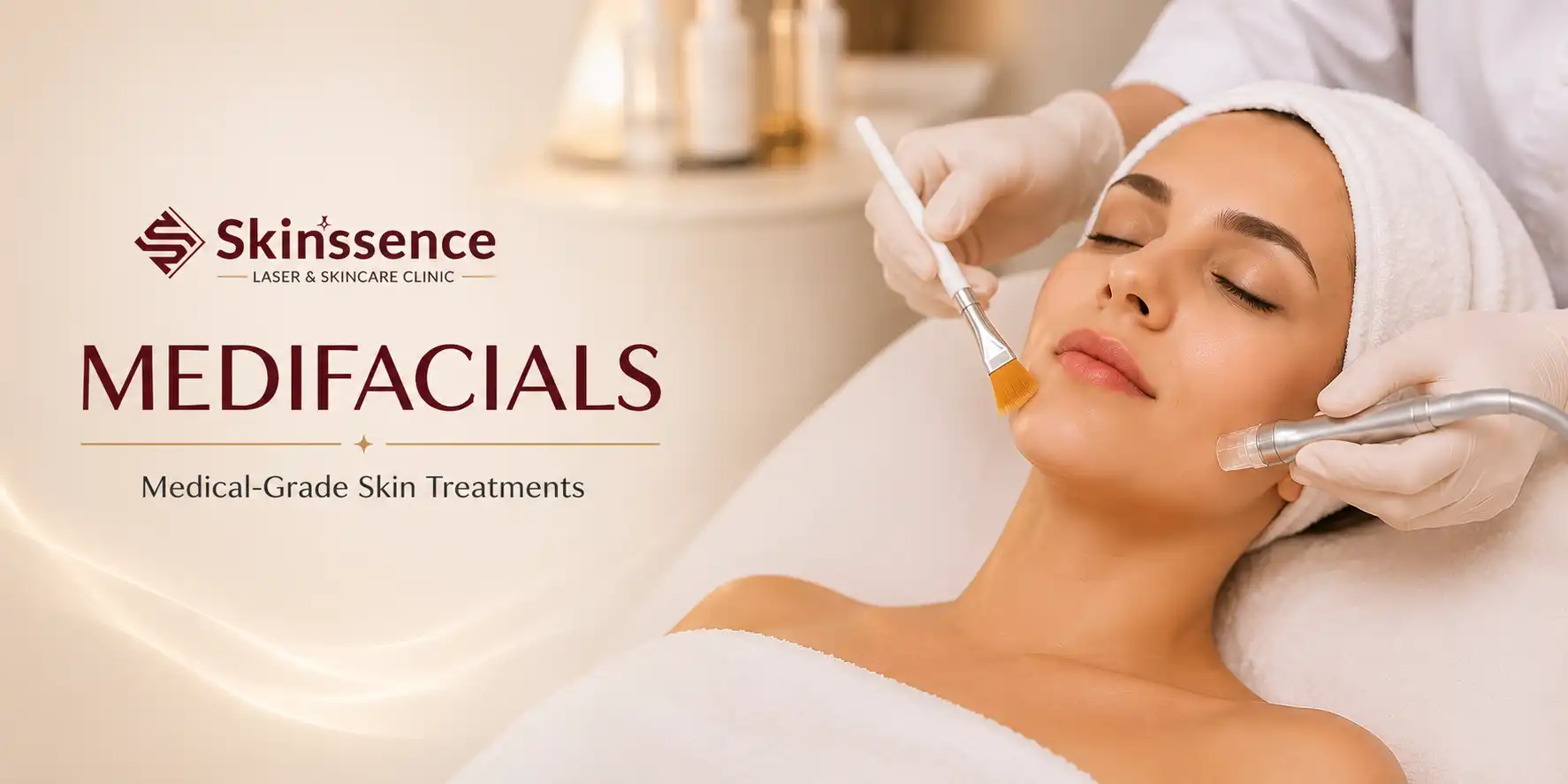
Medical-Grade Medifacials in Kota – by Dr. Ashima Madan
Medical Facials (Medifacials) in Kota — Dermatologist-Supervised at Skinssence
A medifacial is not a salon facial. It is a treatment protocol that uses medical-grade active ingredients and clinical techniques to address specific skin concerns — not to produce temporary surface glow. At Skinssence Laser & Skincare Clinic in Talwandi, Kota, every medifacial protocol is designed and supervised by Dr. Ashima Madan (MBBS, MD, FAM – DJPIMAC, Mumbai) after a skin assessment. The protocol is selected based on what your skin actually needs, not a menu choice.
This page is the hub for all facial treatments at Skinssence. Each treatment type below has its own dedicated page. If you already know your concern, use the treatment selector to go directly to the right guide. If you are not sure, the consultation determines that.
Which medifacial is right for your concern — a quick guide
Start here — match your concern to the right treatment
- You want immediate glow, surface brightness, or pre-event skin: → HydraFacial or carbon laser facial
- You have active acne, oily skin, or recurring breakouts: → Acne control medifacial (see full acne treatment guide)
- You have pigmentation, tanning, or uneven skin tone: → Chemical peel — surface pigmentation responds here; deep or hormonal pigmentation needs dedicated pigmentation treatment
- You have dry, barrier-damaged, or sensitive skin: → Hydration and barrier repair facial (see sensitive skin treatment)
- You want anti-ageing, collagen stimulation, or acne scar improvement: → Vampire Facial (PRP) — the most intensive facial option, requires a clinical assessment
- You are preparing for a wedding or event over 3+ months: → A structured plan — see pre-bridal skincare at Skinssence
The decision between options — and whether a facial alone is sufficient or needs to be combined with a corrective treatment — is confirmed at clinical assessment. Self-selecting a treatment type without an assessment sometimes produces the wrong outcome, particularly for pigmentation and acne-prone skin.
The medifacial treatments available at Skinssence
HydraFacial
Vortex suction combined with active serum infusion — deep cleansing, surface hydration, and immediate glow. The right choice for regular skin maintenance, dehydrated or dull skin, and pre-event preparation. Works best as a maintenance and support treatment, not as a replacement for corrective procedures like peels or PRP.
Best for: immediate brightening, maintenance between deeper treatments, pre-event skin prep
Full HydraFacial guide →Carbon laser facial
Carbon lotion applied to skin; Q-Switch Nd:YAG laser vaporises it, removing dead cells, sebum, and congestion simultaneously. Immediate visible glow after a single session. Particularly effective for oily skin and enlarged pores.
Best for: oily and congested skin, enlarged pores, quick glow before events
Full carbon laser facial guide →Chemical peel facial
Active acid solution applied at clinical concentration — exfoliates surface pigmented layers, controls acne, and stimulates collagen remodelling. Produces deeper structural change than surface maintenance treatments. Requires preparation and aftercare protocol.
Best for: pigmentation, acne, uneven texture, tanning correction
Full chemical peel guide →Vampire Facial (PRP)
Platelet-rich plasma from your own blood applied to microneedled skin — stimulates collagen remodelling, structural anti-ageing, and natural radiance improvement. The most intensive facial option available at Skinssence, with proportionally greater improvement and more recovery time.
Best for: anti-ageing, skin laxity, acne scarring, structural radiance improvement
Vampire Facial guide →Acne control medifacial
Medical-grade sebum regulation, pore cleansing, and anti-inflammatory protocol — designed for oily or acne-prone skin that reacts poorly to standard salon facials. May involve a purging phase in the first 2–3 weeks as congestion clears — this is expected and explained at consultation.
Best for: active acne management, oily skin, post-acne redness
Full acne treatment guide →Hydration and barrier repair facial
Medical-grade peptides, hyaluronic acid complexes, and barrier-repair actives for dehydrated, environmentally stressed, or sensitive skin — gentle enough for reactive skin types that cannot tolerate standard treatment protocols.
Best for: sensitive skin, barrier damage, dryness, post-treatment recovery
Sensitive skin treatment →The right choice depends on your specific concern, skin type, and whether underlying conditions — acne, pigmentation, PCOD, sensitivity — require a modified approach. A dermatologist assessment determines this, not self-selection from a menu.
How medifacials differ from salon facials
| Factor | Salon or spa facial | Medical-grade medifacial at Skinssence |
|---|---|---|
| Who designs it | Beautician or trained technician following a standard menu | Dr. Ashima Madan after clinical skin assessment |
| Active ingredients | Cosmetic-grade actives at low concentration | Medical-grade actives at clinical concentrations |
| Primary goal | Surface glow, relaxation, temporary hydration | Targeted improvement in a specific skin concern |
| Skin assessment before | Usually none or basic discussion | Full clinical evaluation including medical history |
| Immediate glow | Yes — surface effect | Yes for HydraFacial and carbon laser facial; other types build progressively across sessions |
| Long-term skin change | Limited — effect fades within 3–5 days | Measurable improvement in skin condition over a course of sessions |
| Safe for active acne | Often not — salon facials can aggravate active acne | Specific medical protocol for acne-prone skin — different in approach and ingredients from a standard facial |
| Contraindication screening | Usually absent | Screened at assessment — protocol adjusted accordingly for each patient |
Understanding the treatment hierarchy — what each type does
A common source of confusion is treating all medifacials as equivalent options at different price points. They are not. They work at different skin depths and serve different clinical purposes.
The role each treatment plays — and why this matters
- HydraFacial and carbon laser facial: surface maintenance and glow — immediate results, no downtime, used for ongoing upkeep and pre-event preparation. These support the skin between corrective treatments but do not replace them.
- Chemical peel: corrective — targets pigmentation, acne, and texture at a deeper epidermal level. Requires preparation, has a recovery period, and works progressively across sessions. More demanding but produces more lasting structural change.
- Vampire Facial (PRP): the most intensive facial option — stimulates collagen remodelling at the dermal level. Used for anti-ageing, structural laxity, and acne scarring where surface treatments are insufficient.
- Acne control and barrier repair: condition-specific protocols that address the underlying skin state before surface treatments are appropriate.
The typical sequence at Skinssence: corrective work (peel, laser, PRP) at planned intervals, with HydraFacial or carbon laser facial maintaining the skin in between. Using only maintenance treatments while a corrective issue remains unaddressed produces limited long-term improvement.
What to expect — and when results take time
Why some medifacials work immediately and others take weeks
Patients coming from salon backgrounds sometimes feel that medifacials are "too slow." This reaction is understandable — it comes from expecting a surface glow result from a treatment working at a deeper level.
Salon facials hydrate and temporarily plump the outermost skin layer. The result looks good that day and fades within 3–5 days because nothing cellular has changed. Medical facials — particularly acne protocols, barrier repair, and pigmentation-correcting procedures — produce cellular change that becomes visible at the surface over 2–6 weeks. The result lasts weeks to months rather than days.
- HydraFacial and carbon laser facial: visible glow immediately after a single session — comparable to or better than salon results, with more lasting effect
- Acne control medifacial: may involve a brief purging phase in the first 1–2 weeks as congestion clears — this is a normal part of the clearing process, not a treatment failure
- Anti-ageing and barrier repair: gradual improvement over 3–6 sessions — structural change is not visible immediately
- Chemical peel and PRP: more significant recovery period but proportionally greater correction of deeper skin concerns
If immediate visible results in one session are the priority — the HydraFacial or carbon laser facial is the right choice and both are available at Skinssence. If lasting correction of acne, pigmentation, or ageing is the goal, the medical approach takes longer because that is how skin biology works.
The purging phase — what it is and when to contact the clinic
Some patients starting acne-focused medifacials or prescription skincare notice an initial increase in breakouts in the first 2–3 weeks. This is a documented and expected response — the skin clears congestion that was dormant below the surface as cell turnover accelerates. It is temporary and part of the improvement process, not an adverse reaction.
At Skinssence, this is explained before the first session so patients know what to expect and can distinguish a purging phase from an actual problem. A purging phase that resolves within 3–4 weeks is expected. If reactions persist beyond 4 weeks or involve new types of breakouts, a review appointment should be booked — continuing or stopping treatment without clinical input in that scenario is not advisable.
Who should consider a medifacial — and when something else is needed
| Your concern | Right medifacial type | When medifacial alone is not enough |
|---|---|---|
| Dull, dehydrated, or tired skin | HydraFacial — immediate visible hydration and surface glow | — |
| Oily skin, enlarged pores, congestion | Carbon laser facial — immediate oil control and pore refinement | — |
| Active acne and breakouts | Acne control medifacial — medical sebum regulation and anti-inflammatory protocol | Medical acne treatment for deeper or persistent acne not responding to facials alone |
| Surface tanning and mild pigmentation | Chemical peel or carbon laser facial | Dedicated pigmentation treatment for deep, hormonal, or spreading pigmentation |
| Bridal or pre-event preparation | HydraFacial or carbon laser facial in final 2–3 weeks; corrective treatments 3–4 months earlier | Full bridal skincare plan for structured multi-month preparation |
| Anti-ageing — fine lines, skin laxity | Vampire Facial (PRP) — collagen stimulation and structural improvement | PRP combined with laser or MNRF for more significant correction |
| Sensitive or reactive skin | Hydration and barrier repair medifacial — modified protocol with medical-grade barrier actives | Sensitive skin management if barrier damage is the primary concern |
| PCOD-related skin concerns | Acne medifacial can help surface-level — but hormonal management is required alongside | PCOD skin treatment — facial treatment alone cannot address an ongoing hormonal cause |
Medifacials as part of a combination plan
Medifacials work best when used as part of a planned sequence — not as the sole treatment for a skin concern. At Skinssence, they are commonly combined with:
- Laser skin toning — medifacial in the week between toning sessions maintains surface brightness throughout the course
- Chemical peels — medifacial used for barrier recovery in the 2 weeks following a peel session
- Glutathione IV drip — medifacial addresses surface glow while IV therapy works on melanin suppression simultaneously
- Pigmentation treatment — medifacial supports surface clarity between laser toning or peel sessions in a pigmentation course
- Bridal skincare plan — monthly medifacials throughout the plan, with HydraFacial or carbon laser facial in the final 2–3 weeks
Dr. Ashima Madan determines the combination, sequence, and timing at consultation. The medifacial is rarely the entire plan — it is usually one component of a coordinated approach.
Preparation and aftercare
Before your session:
- Inform Dr. Ashima Madan of any current medications — particularly retinoids, isotretinoin, or photosensitising drugs
- Avoid exfoliating scrubs or active skincare for 48 hours before
- Avoid waxing or threading the treatment area for 48 hours before
- Arrive with clean skin — no heavy makeup or SPF on the treatment area
After your session:
- Apply SPF 30+ sunscreen daily — medical-grade actives increase UV sensitivity temporarily
- Avoid harsh exfoliants for 48–72 hours after treatment
- Mild redness is normal and resolves within a few hours for most protocols
- If you experience a purging phase after acne-focused treatment: this is expected for 2–3 weeks — do not stop treatment, but contact the clinic if reactions seem outside the normal range
Related treatments at Skinssence
- HydraFacial in Kota — dedicated page with full treatment detail
- Laser skin toning and carbon laser facial in Kota
- Chemical peels in Kota
- Vampire Facial (PRP) in Kota
- Glutathione IV drip — skin brightening from within
- Body polishing in Kota — surface texture treatment for body skin
- Pre-bridal skincare in Kota — medifacials as part of a structured wedding plan
- HydraFacial in Kota — local presence page
Frequently asked questions about medifacials in Kota
What is the difference between a medifacial and a salon facial?
A medifacial is a protocol designed by a dermatologist using medical-grade actives at clinical concentrations, targeting a specific skin concern after a clinical assessment. Salon facials use cosmetic-grade ingredients at lower concentrations primarily for surface glow and relaxation. The effects of a correctly chosen medifacial last weeks to months; a salon facial effect typically fades within 3–5 days because nothing at the cellular level has changed.
Which medifacial gives instant visible results in one session?
HydraFacial and carbon laser facial both produce immediate visible glow and skin refinement after a single session with no downtime. These are the right choice when visible improvement is needed quickly — before an event, wedding, or occasion. Other medifacial types — acne control, barrier repair, chemical peel — work at a deeper level and build results progressively across sessions. The tradeoff is that those deeper treatments produce changes that last significantly longer.
Why did my skin seem to get worse after starting acne facials?
A brief purging phase — where breakouts temporarily increase in the first 2–3 weeks — is a documented and expected response when medical-grade acne treatments accelerate cell turnover. Congestion dormant below the surface clears faster and becomes visible before resolving. This is not a treatment failure. It resolves within 3–4 weeks in most cases. If you are experiencing this, book a review appointment rather than stopping treatment — stopping prematurely discards improvement that was already in progress. If the reaction involves new types of breakouts or persists beyond 4 weeks, that warrants clinical review.
How many sessions are needed?
It depends on the treatment type and your skin concern. HydraFacial and carbon laser facial produce visible improvement after a single session — monthly sessions are recommended for ongoing maintenance. Acne control, barrier repair, and anti-ageing protocols require a structured course of 4–6 sessions for measurable and lasting improvement. Chemical peel and PRP courses are planned based on clinical assessment. The exact plan is set at the first consultation after examining your skin — not assigned in advance from a standard menu.
Can medifacials be done on sensitive skin?
Yes — but with a specifically modified protocol. Patients with sensitive or reactive skin require lower-concentration actives, patch testing before the full procedure, and a more gradual session sequence. Standard salon facials are often more problematic for sensitive skin than a correctly designed and supervised medical protocol — because the assessment beforehand identifies the triggers that need to be avoided.
Can medifacials help with pigmentation from waxing or post-acne marks?
Surface pigmentation from friction, waxing, or post-acne marks (post-inflammatory hyperpigmentation) responds to chemical peel facial sessions and carbon laser facial treatments. Deeper or hormonal pigmentation — melasma, PCOD-driven discolouration — requires dedicated pigmentation treatment and is unlikely to clear with facial treatments alone. The distinction between surface and deep pigmentation is assessed at consultation and determines the treatment path.
Is HydraFacial the same as a corrective treatment?
No — and this distinction matters. HydraFacial is a maintenance and support treatment. It produces excellent immediate glow, deep surface cleansing, and hydration. What it is not designed to do is correct pigmentation, structural ageing, or acne scarring at the dermal level. Using HydraFacial in place of a corrective treatment — when the concern actually requires a chemical peel, laser, or PRP — produces limited results. The right role for HydraFacial is maintaining skin between corrective treatments and as a standalone for patients whose primary concern is upkeep and brightness.
Are medifacials safe for Indian skin tones?
Yes — when the protocol is designed for the specific skin type and concern. Indian skin (Fitzpatrick types IV–VI) is more prone to post-inflammatory pigmentation, which means the choice of actives, concentration, and treatment frequency requires more careful calibration than for lighter skin types. This is a standard part of the assessment at Skinssence — the protocol used for each patient accounts for their skin's response tendency, not a generic protocol applied uniformly.
Consult Dr. Ashima Madan (MBBS, MD, FAM – DJPIMAC, Mumbai)
Personalized, doctor-supervised treatment plans at Skinssence Laser and Skincare Clinic, Talwandi, Kota.