
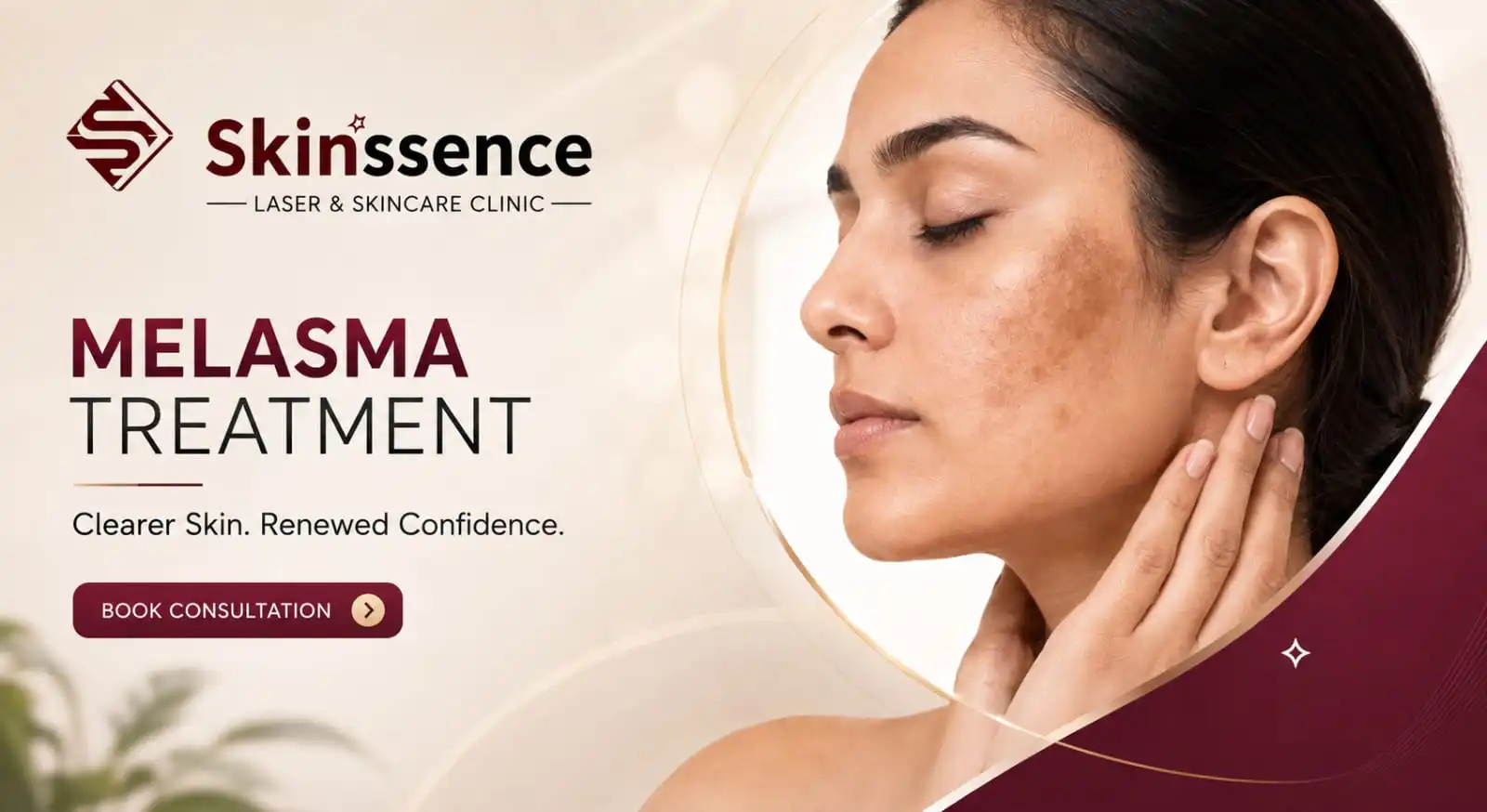
Melasma & Pigmentation Treatment in Kota by Dr. Ashima Madan
Melasma is the condition I most often see mismanaged in Kota. Patients arrive at Skinssence Laser and Skincare Clinic after years of fairness creams, aggressive parlour peels and random laser sessions — with pigmentation that is now deeper, more resistant, and more widespread than when they started. The correct approach is always slow and conservative: stabilise first, correct gradually, maintain long-term. Every shortcut costs the patient more in the long run. — Dr. Ashima Madan (MBBS, MD, FAM – DJPIMAC, Mumbai)
What most patients have already tried before coming to Skinssence
If you are reading this, you are probably not exploring options for the first time. In my experience, the typical melasma patient in Kota has already gone through a recognisable sequence before they come to the clinic.
Two or three creams — some prescribed, some bought at a medical shop on someone's recommendation. A few weeks of sunscreen, then stopped because it felt greasy or didn't seem to be doing anything. Someone told them to get a laser. Someone else told them laser makes pigmentation worse. A parlour offered a "whitening peel." They tried it. It helped for two weeks, then came back darker.
By the time they reach Skinssence, the concern has been present for months or years. Most of them were trying to do the right thing — they just didn’t have a structured plan. The skin has often been through repeated irritation from incorrect products. And the most common thing I hear in that first consultation is: "Doctor, thoda sa theek ho jaye — bas itna ki noticeable na lage."
That is where we actually start. Not from a treatment menu. From understanding why the pigmentation keeps coming back despite everything that has been tried.
What melasma actually is — and why it behaves differently from other pigmentation
Melasma is not a stain. It is a behaviour pattern of the melanocytes — the pigment-producing cells in your skin. This is what decides whether treatment improves melasma — or worsens it.
How melasma differs from other pigmentation
- Melasma: Symmetrical, hormonally influenced, often deep into the dermis, reliably recurrent — requires ongoing management, not a single course
- Post-inflammatory hyperpigmentation: Follows acne, waxing, or a procedure — responds better to treatment, more predictable timeline
- Sun tan and sun spots: Superficial, UV-driven — generally more straightforward to address with peels or laser toning
- PCOD-related pigmentation: Hormonally driven like melasma — needs the hormonal pattern factored into treatment, not just topical correction
Why melasma behaves the way it does
- Pigment often extends into the deeper dermis — surface-only treatments do not reach it
- The melanocytes stay sensitised even after the pigment clears — any UV exposure, heat, or hormonal signal reactivates them
- Aggressive treatment triggers the inflammatory response that drives melanin production — the treatment worsens what it was meant to fix
- Without trigger control, any improvement from treatment is temporary
- Maintenance is not optional — it is the mechanism that prevents recurrence
Why melasma is particularly difficult to control in Kota
Kota's specific environment creates conditions that make melasma harder to manage here than in cooler, lower-UV cities. This is not an excuse — it is a clinical reality that the treatment plan has to account for.
UV exposure — higher than patients realise
Rajasthan receives among the highest UV levels in India year-round. The exposure does not require outdoor activity — a daily scooty ride, the school drop and pick, driving without window tinting, sitting near a sunny window. Even patients who feel they are mostly indoors are often getting enough daily UV to keep melasma active. Sunscreen applied once in the morning and not reapplied does not protect against this.
Heat — the trigger that sunscreen does not stop
Heat independently stimulates melanocytes — not just UV. In Kota's April–June peak, this matters enormously. Patients cooking over a gas flame, sitting outdoors at a wedding in summer, commuting in 45°C heat — all of these reactivate pigmentation even when sunscreen is being used correctly. Physical protection (dupatta, umbrella, avoiding the 12–4 PM window as much as possible) makes a real difference here.
Hormonal factors — PCOD and beyond
PCOD prevalence in the Kota-Hadoti region is significant, and it is a direct melasma trigger. Oral contraceptive use and thyroid imbalance both drive the same hormonal pathway that activates melanocytes. When I see a patient whose pigmentation keeps coming back despite otherwise correct treatment, the first question is whether there is an unaddressed hormonal component running underneath. PCOD skin care →
What actually causes pigmentation to worsen — triggers I discuss in every consultation
Primary triggers
- Sun and UV exposure — the most important and most underestimated
- Heat and infrared radiation (including kitchen heat and Kota's summer temperatures)
- Hormonal changes — pregnancy, oral contraceptives, thyroid imbalance
- PCOD — both directly and through hormonal fluctuation
- Genetic predisposition — some skin types produce melanin more readily in response to any stimulus
What makes existing melasma worse
- Steroid-based fairness creams — initial lightening followed by rebound darkening, then permanent barrier damage
- Unsupervised chemical peels at parlours — the most common cause of converting manageable melasma into resistant melasma
- Skin inflammation from acne, waxing irritation, or harsh scrubs
- Inconsistent or incorrect sunscreen use — SPF 15 applied once does not count
- High-energy laser procedures without prior stabilisation — this is what causes the "laser se aur badh gaya" outcome patients describe
- Lemon juice, raw onion, turmeric paste — these cause skin irritation that activates melanocytes directly
When pigmentation follows acne and keeps recurring alongside breakouts, the acne itself needs to be brought under control medically before pigment correction begins — treating the pigment while the inflammation source is still active produces inconsistent results. Acne treatment at Skinssence →
How I actually approach treatment — three practical tracks
I do not follow a fixed package system. Every face is different in pigment depth, skin sensitivity, lifestyle compliance, how much sun exposure is unavoidable, and what the patient can realistically maintain between sessions. The track chosen at consultation reflects all of these — not just the severity of the pigmentation visible on that day.
Conservative track
For first-time patients, sensitive skin, patients who have already experienced reactions from previous treatment, and anyone whose skin barrier is currently damaged. Medical creams used in rotation (not the same active continuously), sunscreen correction, barrier repair. Results are slower — but this is the safest approach, and for many patients it produces adequate improvement without any procedures at all.
Balanced track — most patients
The approach I use for most patients at Skinssence. Medical topicals combined with mild chemical peels introduced after stabilisation, and laser toning in selected stable cases where it clearly adds to what topicals and peels are achieving. Visible improvement without triggering the inflammatory pathway that causes rebound. This is where patience produces the most durable results.
Intensive track — selected cases only
Resistant melasma in patients who understand the risks, have demonstrated consistent follow-up, and maintain sunscreen and aftercare reliably. Advanced peel combinations and more frequent laser sessions. I only go to this track when I trust that the discipline exists to support it — aggression without that discipline consistently worsens melasma rather than improving it.
The three phases of melasma treatment at Skinssence
Regardless of which track is appropriate, treatment always follows this sequence. Skipping Phase 1 to go directly to procedures is the most reliable way to worsen melasma.
Stabilisation phase
Trigger identification and control — correct sunscreen, heat avoidance habits, hormonal assessment where indicated. Prescription topical therapy to begin regulating melanin production. If the skin barrier is damaged from previous over-treatment, repair comes before anything else. No procedures at this stage. This phase is not slow progress — it is the foundation that determines whether the procedures in Phase 2 produce results or cause rebound.
Correction phase
Targeted treatment introduced gradually once the skin is stable — chemical peels for superficial pigment in selected patients, conservative laser toning only in stable cases where it is clearly the right next step. Intensity is matched to how the skin is responding, not to a predetermined schedule. The patient's compliance with sunscreen and aftercare between sessions directly determines how much can be safely introduced here.
Maintenance phase
Long-term measures to prevent relapse — this is the phase most patients stop too early because they see improvement and assume the melasma is gone. It is not gone. The melanocytes are quieter. Maintenance topical therapy, seasonal adjustment (summer requires more conservative management than winter even with sunscreen), and periodic review are what keep the improvement from reversing. Patients who maintain correctly see significantly better long-term outcomes than those who treat episodically.
What the treatments actually do
Medical and topical therapy — always the foundation
Prescription creams regulate melanin activity, reduce inflammation, and restore the skin barrier. This is not a starting point to skip in favour of faster procedures — it is the mechanism that makes every other treatment safer and more effective. Many patients achieve adequate improvement with medical therapy alone when it is used correctly and consistently, which most of them have not had the chance to do before.
Chemical peels — selective, not routine
Introduced after the stabilisation phase in carefully selected patients with superficial pigmentation. Peel type, concentration, and spacing are determined by me after examining how the skin is responding — not from a fixed protocol. Peels are never aggressive on melasma-prone skin. The most common reason patients arrive with post-peel darkening from elsewhere is that the peel was applied to unstabilised melasma without preparation.
Chemical peels at Skinssence →Laser toning — only in stable, selected cases
Q-Switch Nd:YAG laser at conservative settings is considered only after pigment has been stabilised medically. I rarely use laser as a first-line melasma treatment. The "laser se aur badh gaya" outcome patients describe consistently — premature laser on unstabilised melasma at aggressive settings without pre and post-care. When correctly timed and dosed in the right patient, laser toning improves overall skin tone and residual pigment that topicals alone are not reaching.
Laser skin toning →Sunscreen — the single most important part of treatment
I tell every melasma patient this: if sunscreen is inconsistent, every other part of the treatment produces only temporary results. Broad-spectrum SPF 50+ applied in the morning and reapplied during the day prevents UV from continuously reactivating sensitised melanocytes. In Kota's environment, physical or mineral sunscreen is preferred — it offers better protection against heat and visible light compared to most chemical sunscreens. Sunscreen is not preparation for treatment. It is treatment.
The honest answers to what most patients ask me
"Kya permanent thik ho jayega?" No. Melasma can be controlled long-term — the pigmentation becomes lighter, the flare-ups become less frequent, the skin looks more even. But the melanocytes remain sensitised. Stop maintaining and the pigmentation returns. This is the biology of the condition, not a failure of treatment.
"Bas ek strong treatment kar do." This is exactly what produces the worst outcomes in melasma. Aggressive treatment triggers the inflammatory pathway that drives melanin production — the skin gets darker, not lighter. Fast results in melasma are almost always short-lived, and the rebound is worse than the starting point. Slow and conservative consistently outperforms aggressive in this specific condition.
"Doctor, wapas aa gaya." Yes — and usually for a known reason. Sunscreen stopped or not reapplied. Maintenance creams stopped once the skin looked better. A Kota summer with daily outdoor exposure. A wedding season with evening functions in the heat. The relapse is not random. Once patients understand their specific triggers, the relapses become predictable and manageable instead of demoralising.
"Natural kuch ho sakta hai?" Basic sun protection and heat avoidance are the most natural and effective things a melasma patient can do. Home remedies — lemon juice, turmeric, onion — cause skin irritation that directly activates melanocytes and makes pigmentation worse. I have seen this enough times that I now ask specifically about home remedies in every consultation.
— Dr. Ashima Madan, MBBS, MD, FAM (DJPIMAC, Mumbai)
When melasma treatment should be delayed
At Skinssence, treatment decisions are deferred when any of the following apply. Proceeding in these situations predictably worsens the condition.
- Current pregnancy or immediate post-partum period — most corrective treatments are deferred; medical management is adjusted to what is safe in this phase
- Active skin irritation, infection, or a compromised barrier from previous over-treatment — repair first
- Recent use of unregulated chemical peels, steroid creams, or mercury-containing fairness products — the skin needs time to stabilise before any new treatment is introduced
- Sun exposure cannot be adequately controlled during the treatment phase — procedures during a period of unavoidable heavy sun exposure produce inconsistent results
- Suspected hormonal or thyroid triggers that have not yet been assessed — addressing the underlying driver changes what treatment is appropriate
These are clinical delays, not permanent contraindications. All of them are identified at the initial consultation so the plan accounts for them from the start.
Who should see a dermatologist for melasma in Kota
- Pigmentation that is spreading, darkening, or not responding to anything tried
- Melasma that has worsened after treatment done elsewhere — parlour peels, laser at a non-medical clinic, or self-prescribed products
- Pigmentation that appeared or worsened during pregnancy, post-pregnancy, or after starting oral contraceptives
- PCOD or thyroid disorder with facial pigmentation — the hormonal component needs to be in the treatment thinking
- Patients with sensitive or reactive skin where incorrect product use carries higher risk of permanent worsening
- Anyone who has been using steroid-based fairness creams long-term and has noticed the skin becoming thinner, more reactive, or breaking out
Clinic details — Skinssence, Talwandi, Kota
Frequently asked questions — melasma treatment at Skinssence, Kota
Is melasma a permanent condition?
It is chronic and recurrence-prone — not permanently cured, but controllable. With consistent dermatologist-guided treatment and maintenance, pigmentation lightens significantly and flare-ups become less frequent and less severe. Patients who maintain correctly over time see results that hold. Patients who treat episodically — improve, stop everything, treat again when it returns — get a worse outcome over the same period. The biology of the condition does not change, but how much it affects daily life can be managed significantly.
Can melasma be treated without laser?
Yes — and for most patients, this is where treatment should start. Medical therapy combined with strict sunscreen and correctly selected chemical peels produces significant improvement in the majority of melasma patients without any laser involvement. Laser toning at Skinssence is considered only in selected stable cases where topicals and peels have done their job and laser adds to what they have achieved. Laser as a first-line melasma treatment — particularly at aggressive settings — is what produces the darkening that patients then need to come and have corrected.
Why does melasma keep coming back after treatment?
Because the melanocytes remain sensitised even after the pigment has cleared. The trigger reactivates them — UV exposure, heat, hormonal fluctuation, inconsistent sunscreen. Most relapses trace back to a specific trigger: a summer with inadequate protection, maintenance stopped after visible improvement, a hormonal change. Once patients identify their personal triggers, relapses become predictable and manageable rather than demoralising. The answer is not a stronger treatment — it is better trigger control.
Can melasma worsen with treatment?
Yes — with incorrect treatment. Aggressive peels on unstabilised melasma, high-energy laser without preparation, steroid-based fairness creams used long-term, and heat-producing cosmetic procedures all carry real risk of converting manageable melasma into a resistant, deeper form. The patients who have the hardest recovery at Skinssence are those who had aggressive treatment elsewhere before coming. This is why a dermatologist assessment before any intervention matters — not to be conservative for its own sake, but because the cost of getting it wrong in melasma is high.
How long before I see results from melasma treatment?
Gradual improvement is typically visible over 8–12 weeks of consistent medical therapy combined with strict sun protection. The improvement continues progressively across phases. I tell patients at the first consultation that improvement in melasma is measured in months — not sessions or weeks. Patients who come expecting visible change after two or three appointments are usually setting themselves up for frustration and premature abandonment of a plan that was working.
Is pigmentation treatment safe in Kota's summer?
Medical topical therapy is safe year-round. Procedural treatments — chemical peels and laser — require careful timing in Kota's summer given the UV and heat exposure during healing. I adjust procedure scheduling seasonally for Kota patients — what is appropriate in November is different from what is appropriate in May. Summer is typically a maintenance phase, not a correction phase, for patients in Rajasthan.
Does sunscreen actually make a difference for melasma?
It is the single most important part of every melasma treatment plan at every stage. Without consistent SPF 50+ use — applied correctly and reapplied during the day — every other part of treatment produces only temporary results. In Kota's UV and heat environment, physical or mineral sunscreen is preferred over chemical filters because it also blocks infrared radiation, which chemical sunscreens do not address. I assess sunscreen use at every follow-up — not as a formality but because it is directly determining whether the treatment is working.
Are parlour treatments or home remedies effective for melasma?
No — and both carry genuine risk of worsening it. Home remedies including lemon juice, raw onion, and turmeric paste cause skin irritation that directly activates melanocytes and deepens pigment. Parlour peels applied without dermatologist supervision and preparation convert superficial melasma into deeper, more treatment-resistant forms on a regular basis. The patients who are hardest to treat at Skinssence are those who had years of parlour peels before a medical assessment. A dermatologist consultation before any intervention prevents this.
Cost of melasma treatment — what patients should realistically expect
One of the most common concerns is cost — especially because melasma is not a one-time treatment.
I discuss this clearly during consultation. Treatment is planned in phases, and it can be adjusted based on what the patient is comfortable maintaining. What does not work is trying to compress everything into one or two aggressive sessions to “save cost” — that usually increases long-term expense because of relapse or worsening.
A structured, gradual approach is almost always more cost-effective over time than repeated short, aggressive treatments that need to be corrected later.
Book a Melasma Consultation at Skinssence, Kota
Skinssence Laser and Skincare Clinic — Talwandi, Kota
Dr. Ashima Madan — MBBS, MD, FAM (DJPIMAC, Mumbai)
Structured, phase-based treatment. Conservative where needed. Clear expectations from the first consultation.
Consult Dr. Ashima Madan (MBBS, MD, FAM – DJPIMAC, Mumbai)
Personalized, doctor-supervised treatment plans at Skinssence Laser and Skincare Clinic, Talwandi, Kota.