
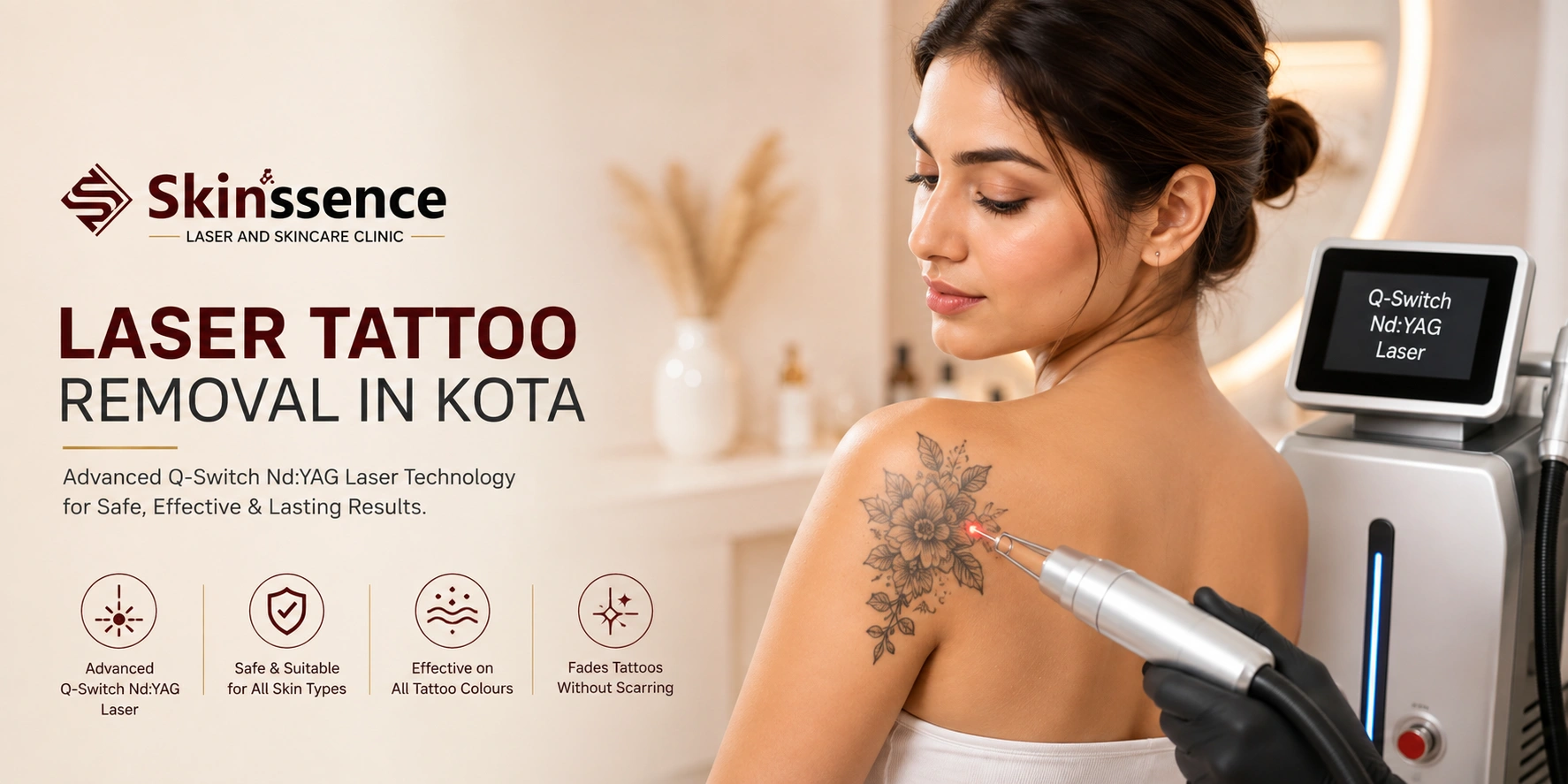
Laser Tattoo Removal in Kota – Q-Switch Nd:YAG by Dr. Ashima Madan
Laser Tattoo Removal in Kota — Visible Fading, Safely Done
Most patients who come for tattoo removal in Kota are not coming casually. They have a reason that matters to them — a defence recruitment physical coming up, a name they cannot look at anymore, or a design that made sense at 18 but doesn't at 28. Whatever your reason, it is understood without judgement at Skinssence.
And almost every one of them asks the same first question: "How fast can this be done, and how much will it cost?" Both are answered honestly — based on your tattoo, not a generic number.
Laser tattoo removal at Skinssence Laser & Skincare Clinic, Kota uses Q-Switch Nd:YAG dual-wavelength laser supervised by Dr. Ashima Madan (MBBS, MD, FAM – DJPIMAC, Mumbai). Most patients see visible fading after the first session. Black ink — the most common type in Kota — fades progressively and predictably across a planned course of sessions.
Quick Reference — Laser Tattoo Removal at Skinssence, Kota
- Dermatologist-supervised Q-Switch Nd:YAG laser (1064nm + 532nm dual-wavelength)
- Visible fading begins after session 1 in most patients
- Typical course: 6–12 sessions spaced 6–8 weeks apart
- Best results for black and dark ink — most common in Kota
- Safe for Indian skin (Fitzpatrick III–V) — settings calibrated per session
- Session estimate given after Dr. Ashima Madan examines your tattoo
- Defence recruitment and job deadline cases: timeline-aware planning available
- Per-session cost and total estimate given at consultation — no mid-course surprises
Skinssence Laser & Skincare Clinic, Sector 4, Talwandi, Kota | +91 95091 97578
Is laser tattoo removal right for you — quick guide
✓ Best candidates — start now
- Black or dark ink tattoo
- Defence recruitment / govt job deadline 6+ months away
- Name tattoo — forearm, wrist, chest
- Planning a cover-up tattoo over an old one
- Older tattoo (body has already begun fading it)
⚠ May need longer course
- Coloured tattoo (red, orange, green, blue)
- Professionally done tattoo (deeper, denser ink)
- Large or multi-colour design
- Previously treated at a salon or low-power machine
- Tattoo on hands, feet, ankles (slower clearance)
✗ Not ideal to start immediately
- Skin is currently tanned (4-week wait needed)
- Active infection at tattoo site
- Isotretinoin use within 6 months
- Deadline under 2 months away — discuss at consultation
All the above are assessed at consultation. Most "not ideal" situations are temporary — they do not permanently disqualify treatment.
Who comes to Skinssence for tattoo removal in Kota
Defence recruitment — army, BSF, CRPF, police
This is the most common reason patients consult urgently. Visible tattoos on hands, forearms, neck, or face disqualify candidates from most armed forces and paramilitary recruitment processes. The physical examination is strict — even faded tattoos can be flagged if still visible. If you have a recruitment physical coming up, the earlier you start, the more sessions you can complete before your exam date. Tell Dr. Ashima Madan your exact timeline at the first consultation — the plan is structured around your deadline, not a standard schedule.
Name tattoos — after a breakup or relationship change
Name tattoos are the single most common tattoo regret, and the most personal reason patients come for removal. There is no judgement here — this is a practical decision, and it is one of the most straightforward cases for laser removal. Black ink names on forearms, wrists, or chests are among the fastest-responding tattoos. Many patients achieve near-complete or complete removal within a planned course. Starting the conversation is the hardest part — the treatment itself is far more manageable than most expect.
Government job — visible tattoo disqualification
Many government positions — including banking, railway, and state government roles — have appearance guidelines that restrict visible tattoos. If your tattoo falls in a visible area and you have a recruitment or interview timeline, the treatment plan is structured accordingly. Significant fading is achievable within a planned course even if complete removal takes longer.
Design regret — teenage decision, style change
A tattoo that felt right at 18 may not feel right at 28 or 35. This is not a sign of weakness — it is a practical decision. Most design tattoos respond well to treatment, with fading that makes the tattoo substantially less visible or undetectable. The goal is not always complete removal — for many patients, significant fading that makes the tattoo no longer noticeable is the outcome they want.
Professional or family reasons
Visible tattoos on hands, neck, or face create challenges in certain professional settings or family situations — particularly in Kota's social environment. Removal or significant fading addresses these practically, without surgery and without extended recovery.
Partial removal — fading for a cover-up
If you want a new tattoo over an existing one, partial laser fading first gives your tattoo artist a much better canvas. A few sessions can lighten an old tattoo enough for a new design to be placed without the old ink showing through. You do not need complete removal for this — which also means fewer sessions and lower total cost.
Why choose Skinssence for tattoo removal in Kota
Dual-wavelength Q-Switch Nd:YAG
Skinssence uses a Q-Switch Nd:YAG laser at both 1064nm (black, dark blue, grey) and 532nm (red, orange, brown). Many clinics in Kota operate single-wavelength devices and cannot treat coloured ink. If your tattoo has multiple colours, this matters significantly — different wavelengths target different ink depths in the same session.
Dermatologist — not a technician
Every session at Skinssence is supervised by Dr. Ashima Madan (MBBS, MD). Laser energy is calibrated per session based on your skin's current response — not a fixed protocol applied regardless of outcome. This calibration is what prevents scarring and pigmentation complications in Indian skin.
Indian skin — specific protocol
Indian skin (Fitzpatrick III–V) requires specific energy settings. Too aggressive and you get post-inflammatory pigmentation or textural scarring. The biggest risk with tattoo removal in Indian skin is not scarring — it is pigmentation from incorrectly calibrated treatment. Dr. Ashima Madan adjusts settings every session based on how your skin responded to the previous one.
Honest session and cost estimate upfront
You will know your realistic session count and per-session cost before treatment starts — not discover it session by session. Dr. Ashima Madan examines your tattoo directly at consultation and gives you a specific, informed estimate. No surprises mid-course. No packages that commit you before you understand what you are committing to.
Physical clinic in Kota — same doctor, every visit
Skinssence is located in Talwandi, Kota — not a Jaipur or Delhi clinic targeting Kota searches online. Your treating doctor is here. Follow-up visits, session monitoring, and any post-treatment concerns are managed in the same clinic by the same doctor who did your first consultation.
Pain is managed — numbing before every session
Numbing cream is applied before every session, significantly reducing discomfort. After numbing, the sensation is a quick elastic snap. A small tattoo takes 5–10 minutes of actual laser time. Comfort improves across sessions as ink density reduces. Most patients describe it as manageable — not comfortable, but tolerable.
How treatment decisions are made — the clinical protocol at Skinssence
Dr. Ashima Madan on real tattoo removal protocol
Every tattoo is not treated with a fixed setting. Three things are adjusted at every session:
- Energy level — based on your skin's response to the previous session. If there was any pigmentation tendency, energy is reduced and interval is extended rather than pushing harder for faster fading.
- Spot size — adjusted depending on tattoo depth, diffusion, and the area being treated in that session.
- Pass count — controlled to avoid over-treatment. Indian skin does not tolerate the same aggressiveness as lighter skin types. Over-treating produces pigmentation, not faster removal.
If your skin showed even a mild pigmentation response after the previous session, I reduce aggressiveness and extend the interval before the next one. This adds sessions — but it produces clean skin at the end, not marks over a cleared tattoo.
— Dr. Ashima Madan, Skinssence
What happens in a laser tattoo removal session — step by step
| Step | What happens | What you experience |
|---|---|---|
| Numbing | Topical numbing cream applied 20–30 minutes before laser | No sensation — area becomes numb |
| Laser treatment | Q-Switch pulses targeted at tattoo ink — ink shatters into microscopic fragments | Quick elastic snapping sensation; very fast — small tattoos take 5–10 minutes |
| Frosting | Treated area shows temporary white frosting — confirms ink is being targeted correctly | White appearance on tattoo for 10–20 minutes — normal and expected |
| Cooling | Treated area cooled; post-care ointment applied | Mild redness and swelling — resolves within hours for most patients |
| After session — weeks 1–6 | Body's immune system clears fragmented ink particles — progressive fading occurs | Tattoo visibly lighter over following weeks |
Total session time: 30–45 minutes including numbing. You leave the same day and resume normal activity immediately.
Which ink colours respond — and what to expect
| Ink colour | Response to Q-Switch laser | Realistic outcome |
|---|---|---|
| Black, dark grey | Excellent — fastest responding | Complete or near-complete removal achievable for most cases |
| Dark blue, navy | Very good | Significant to complete fading achievable |
| Red, orange, brown | Good — 532nm wavelength | Significant fading; may need more sessions than dark ink |
| Yellow, white, light green, pastels | Poor — these inks do not absorb Q-Switch wavelengths | Limited fading regardless of sessions — disclosed at consultation |
How many sessions will your tattoo need
The honest answer depends on your specific tattoo. These are the factors that determine your session count:
| Factor | Fewer sessions | More sessions |
|---|---|---|
| Ink colour | Black, dark blue | Red, orange, multiple colours |
| Tattoo age | Older tattoo (body has partially faded) | Newer tattoo (fresh ink, full density) |
| Who did it | Amateur tattoo (less ink depth) | Professional tattoo (deeper, denser ink) |
| Location on body | Upper arm, chest, back (good circulation) | Hands, feet, ankles (slower clearance) |
| Size and density | Small, simple, single colour | Large, dense, multi-colour |
Typical range: 6–12 sessions for significant fading on most tattoos. Black name tattoos in accessible locations often need fewer. Large professionally applied multi-colour designs need more. Dr. Ashima Madan gives a specific estimate after examining your tattoo at consultation — this is the only number that matters for your case.
What fading looks like across sessions
Session-by-session — what patients typically experience
- After session 1: Ink fragmentation has begun. Visible lightening in the weeks following — the tattoo will look lighter than before treatment. Most patients find this reassuring — the mechanism is visibly working.
- After sessions 2–4: Progressive, cumulative fading. The tattoo becomes noticeably lighter. Edges begin to break up. Many patients find this is when they feel confident the treatment is working as planned.
- After sessions 5–8+: Continued fading toward the treatment goal — significant lightening, near-invisibility, or complete removal depending on tattoo type and depth.
- Why you must wait 6–8 weeks between sessions: Each session fragments ink. Your immune system then clears those fragments — a process that takes 6–8 weeks. Sessions done closer together do not produce faster results — they re-fragment ink already being cleared, waste laser energy, and increase the risk of pigmentation in Indian skin. Correct spacing produces better final skin quality. This is not caution for its own sake — it is how the mechanism works.
What Dr. Ashima Madan sees most often in Kota — real patient patterns
Defence recruitment urgency — the most common case
Candidates arrive 2–6 months before their army, BSF, or police physical expecting full removal. The realistic picture: black ink tattoos in accessible locations can achieve dramatic fading within a planned course. Complete clearance depends on the tattoo. The plan is structured to maximise fading within the available timeline, with honest guidance on what is achievable before the specific exam date.
Black name tattoos — the highest success group
Usually forearm or wrist. These respond fastest and most completely. Many achieve near-complete removal within a planned course of sessions. The name is no longer visible — and for most patients, that is the outcome that matters, not technical "complete removal" on a document.
Previously treated outside Kota — complex cases
Patients who had partial removal done at salons, parlours, or low-power machines elsewhere require more careful management. Under-treated sessions can create uneven ink distribution and increase pigmentation risk for subsequent correct laser sessions. These cases are assessed carefully at consultation before a plan is given.
Cover-up preparation — partial fading, not full removal
Patients planning a new tattoo over an old one. For these cases, full removal is not needed — controlled lightening to a level where new ink can be placed cleanly is the goal. This typically needs fewer sessions and costs less than full removal. The specific target is agreed at consultation based on what your tattoo artist has advised.
Cost of laser tattoo removal in Kota — what determines it and how to plan
Cost hesitation is the most common reason patients delay starting — and delay is the one thing that works against you, especially with a recruitment deadline. Here is how cost works at Skinssence, without vagueness:
What determines your cost:
- Tattoo size — a small wrist name costs significantly less per session than a large forearm or back design
- Ink colours — black-only is simpler than multi-colour
- Number of sessions needed — which depends on all the factors above
What you get at consultation: Dr. Ashima Madan examines your tattoo and gives you a per-session cost and a realistic total session estimate — so you know the full range before committing to a single session. There are no packages that lock you in before you understand your case.
Send your tattoo photo on WhatsApp (+91 95091 97578) for a preliminary cost discussion before booking a consultation.
The most common mistakes that increase session count and cost
What adds sessions — and avoidable cost
- Starting too late before a deadline: The most common — and the most costly. Each session you cannot complete before your exam is fading that didn't happen. Start as early as possible.
- Going to a salon or low-power setup first: Under-powered machines do not remove ink — they redistribute it unevenly and can cause surface changes that make subsequent correct laser sessions more difficult. If you've had treatment elsewhere, disclose this at consultation.
- Doing sessions too close together: Expecting faster results by reducing the interval. This wastes laser energy, clears less ink per session, and increases pigmentation risk. The 6–8 week interval is not a waiting period — it is the period when fading actually happens.
- Not following post-care: Picking scabs, sun exposure without SPF, swimming too soon — these are the primary causes of post-inflammatory pigmentation after correct treatment. They add sessions and cost that were entirely avoidable.
- Stopping mid-course after initial fading: The tattoo appears significantly lighter and some patients stop. Residual ink at depth — not visible to the eye yet — continues to be present and can resurface or create patchy results. Completing the planned course gives clean final skin.
Before and after your session — what to do
Before each session:
- Avoid sun exposure and tanning on the tattoo area for 4 weeks before — fresh tan significantly increases pigmentation risk
- Shave the tattoo area if it has hair — surface hair absorbs laser energy
- Arrive with clean skin — no cream, oil, or cosmetics on the tattoo
- Disclose any medications to Dr. Ashima Madan — particularly isotretinoin (Accutane) or photosensitising drugs
After each session:
- Apply the prescribed ointment as directed — do not substitute generic creams
- Do not pick or scratch scabs — this is the single biggest cause of scarring and pigmentation after tattoo removal
- Keep the area clean and dry for 48 hours
- SPF 30+ on treated area — mandatory until fully healed
- Avoid swimming pools, gyms, and saunas for 2 weeks after each session
What is not done at Skinssence
Commitments on clinical practice
- Complete removal is not promised in a fixed number of sessions — because ink composition, depth, and body location determine that, not a standard protocol
- Tanned skin is not treated — the pigmentation risk is too high, and producing marks over a cleared tattoo is a worse outcome than waiting a few weeks
- Laser power is not increased aggressively to show faster results — faster fading with pigmentation is a worse outcome than slower fading with clean skin
- Treatment is not started without discussing realistic outcomes first — what is achievable for your specific tattoo, in your specific timeline, is explained before the first session
- Packages that commit you to multiple sessions before your tattoo has been examined are not offered — the estimate comes after assessment, not before
When treatment is postponed — assessed at consultation
Treatment is postponed or modified for: active infection at tattoo site, pregnancy, recent tanning or sunburn on the area, keloid scarring history, isotretinoin use within 6 months, or active skin conditions at the site. All of these are assessed at consultation — most are temporary reasons to wait, not permanent disqualifiers.
Frequently asked questions — laser tattoo removal in Kota
Can my tattoo be completely removed?
Yes — for many tattoos, particularly black ink, complete or near-complete removal is achievable. Older black tattoos in accessible locations have the best outcomes. Complete removal cannot be guaranteed for all tattoos — ink composition, depth, and body location all affect final results. What is realistic for your specific tattoo is discussed honestly at consultation, before any treatment begins and before any money is spent.
I have a defence / army / police recruitment physical — can this be removed in time?
This is one of the most common situations at Skinssence. The answer depends on your tattoo and your timeline. Black ink tattoos — the most common type — respond fastest and often achieve dramatic fading within a planned course. Tell Dr. Ashima Madan your exact exam or recruitment date at the first consultation — the treatment plan is structured to maximise fading within your timeframe. Starting as early as possible gives you the most sessions before your deadline. If your timeline is under 2 months, discuss this at consultation — realistic expectations will be set honestly.
I want a name tattoo removed — how many sessions does it typically need?
Name tattoos — typically black ink, small to medium size — are among the most straightforward cases for laser removal. Most need 4–8 sessions for significant to near-complete fading, depending on size, ink density, and age of the tattoo. Black ink names on forearms and wrists respond well and predictably. Dr. Ashima Madan gives a specific estimate after examining your tattoo at the first consultation.
How much does tattoo removal cost in Kota?
Cost depends on tattoo size, ink colours, density, and the number of sessions needed. A small black name tattoo costs significantly less per session — and needs fewer sessions — than a large multi-colour design. A per-session cost and realistic total estimate is given after Dr. Ashima Madan examines your tattoo at consultation. You do not need to commit to all sessions upfront. If you want a preliminary idea before booking, send a clear photo of your tattoo on WhatsApp (+91 95091 97578) — a rough estimate can often be given based on the photo before your first visit.
Is tattoo removal painful?
Numbing cream is applied before every session at Skinssence, which significantly reduces discomfort. After numbing, the sensation is a quick elastic snap — not comfortable, but manageable for most patients. A small tattoo takes 5–10 minutes of actual laser time. Comfort improves across sessions as ink density and the amount of ink being targeted reduces. Most patients describe the experience as tolerable once numbing takes effect.
Will my skin look normal again after the tattoo is removed?
For most black ink tattoos treated with correct technique and proper aftercare, the skin returns to its natural appearance. In some cases — particularly where tattoo ink was very deep, or where aftercare was not followed — a subtle textural change or faint ghost of the tattoo may remain. This is why correct treatment calibration and aftercare (especially not picking scabs) matter significantly. At consultation, realistic expectations for your specific case are discussed honestly.
Why do I need to wait 6–8 weeks between sessions?
Each session fragments ink into microscopic particles. Your immune system then clears those particles — and this process takes 6–8 weeks. The next session should happen after this clearance is substantially complete. Sessions done closer together do not produce faster results — they re-fragment ink already being cleared, waste laser energy, and in Indian skin, increase the risk of pigmentation. Correct spacing is what produces the best final skin quality. This is not caution — it is how the mechanism works.
Is laser tattoo removal safe for Indian skin?
Yes — when performed under dermatologist supervision with correctly calibrated settings. Indian skin (Fitzpatrick III–V) requires specific energy parameters to avoid post-inflammatory pigmentation. The biggest risk in Indian skin is not scarring — it is pigmentation from settings that are appropriate for lighter skin types but too aggressive for Indian skin. Dr. Ashima Madan adjusts settings per session based on your skin's current response. This adjustment is what makes the difference between clean fading and pigmentation complications.
Can coloured tattoos be removed at Skinssence?
Yes — the Q-Switch Nd:YAG at Skinssence operates at both 1064nm (black, dark blue, grey) and 532nm (red, orange, brown). Multi-colour tattoos can be treated in the same session, with different wavelengths targeting different inks. Yellow, white, and pastel inks do not respond well to any Q-Switch wavelength — if your tattoo contains these colours, this is disclosed at consultation along with realistic expectations for those specific inks.
I had treatment at a salon before — can I continue here?
Yes, but the previous treatment history affects the plan. Salon or low-powered machine treatments often do not fully fragment ink — they can redistribute it unevenly and create surface changes that require more careful management in subsequent sessions. Disclose all previous treatment at your consultation. Dr. Ashima Madan assesses the current state of the tattoo and adjusts the plan accordingly. Previously treated tattoos are not automatically harder to remove — but they require informed assessment before starting.
Related treatments at Skinssence, Kota
Patients who consult for tattoo removal often have related concerns addressed at the same time:
- Laser Skin Toning — for overall pigmentation, uneven tone, or tanning on surrounding skin
- Melasma & Pigmentation Treatment — if post-inflammatory pigmentation is a concern alongside tattoo removal
- Acne Treatment — often addressed concurrently for patients consulting for other skin concerns
- Mole Removal — non-surgical mole removal at the same clinic
See the full cosmetic dermatology treatment list or technology overview at Skinssence.
If you have a defence recruitment, exam, or job deadline, mention it — your plan is structured around your timeline, not a standard schedule.
Dr. Ashima Madan (MBBS, MD, FAM – DJPIMAC, Mumbai) · Dermatologist since 2003
Mon–Sat: 11am–1:30pm & 4pm–7:30pm | Sunday: 11am–1:30pm
Book online → | +91 95091 97578 | Find us in Kota →
Consult Dr. Ashima Madan (MBBS, MD, FAM – DJPIMAC, Mumbai)
Personalized, doctor-supervised treatment plans at Skinssence Laser and Skincare Clinic, Talwandi, Kota.