
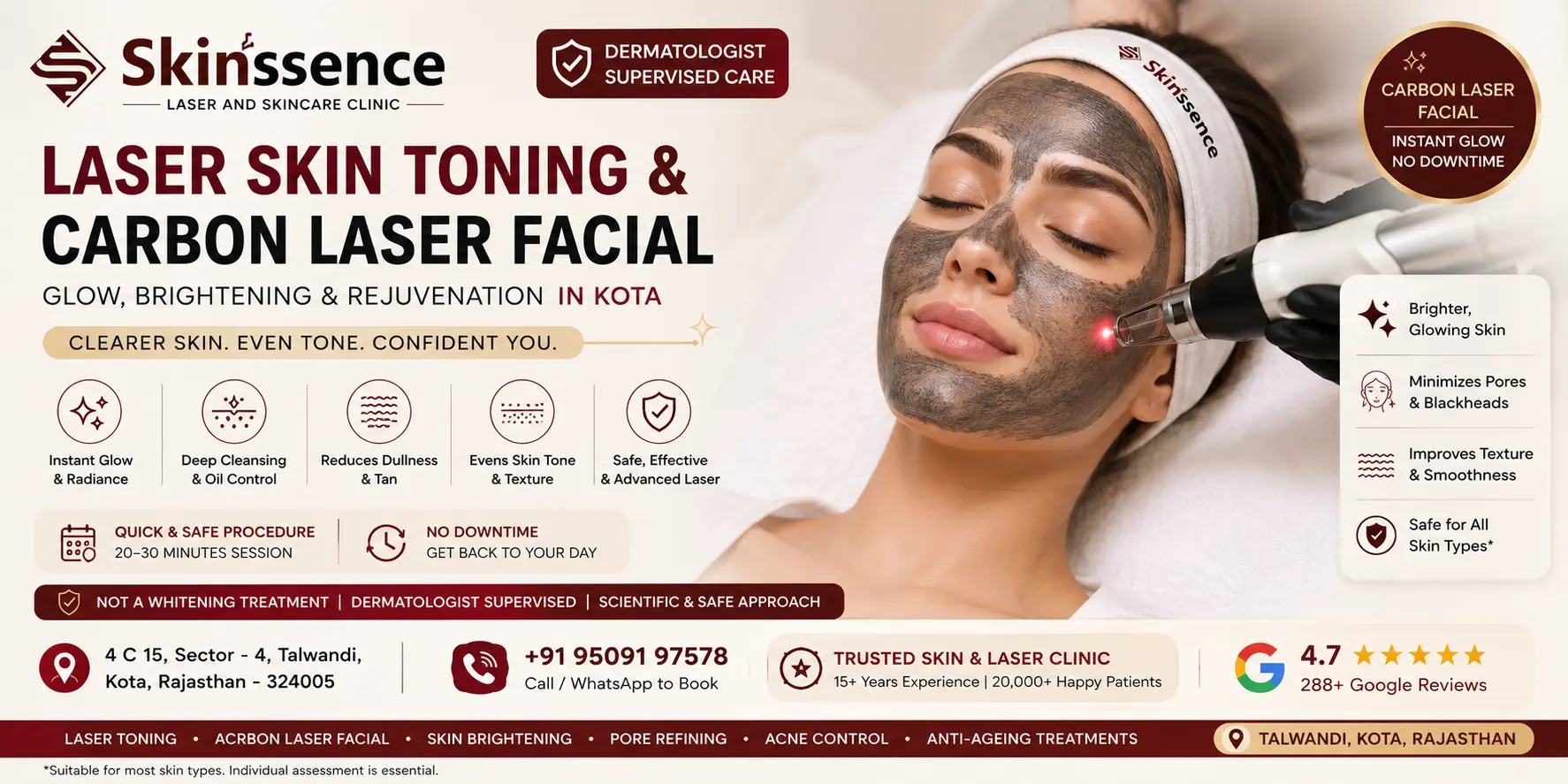
Laser Skin Toning & Carbon Laser Facial in Kota – Glow, Brightening & Rejuvenation
Laser Skin Toning and Carbon Laser Facial in Kota — When It Works, When I Say No
Most patients come to Skinssence asking for laser toning with one of three requests: "glow aa jaye," "carbon facial before the wedding," or "bas 1–2 sessions mein clear ho jaye." My first response is often not yes to any of these — not because laser does not work, but because in the wrong skin, at the wrong time, with the wrong expectation, it either does very little or can make things worse.
At Skinssence Laser & Skincare Clinic in Talwandi, Kota, Dr. Ashima Madan (MBBS, MD, FAM – DJPIMAC, Mumbai) supervises every laser session directly. Settings are calibrated at each appointment based on your current skin condition — not carried over from a previous session or applied from a standard protocol. The machine may be similar across clinics. What determines the outcome is the judgement applied to every parameter before and during the procedure.
Who actually benefits from laser toning — and who does not
This is the part most clinic pages skip. Laser works well in a specific set of conditions, and the outcomes when those conditions are met are genuinely good. When they are not met, the same procedure produces inconsistent results or complications.
Laser skin toning works well when: pigmentation is already stable, the skin barrier is intact, the patient is disciplined with sunscreen between sessions, expectations are realistic — gradual improvement in tone and texture over weeks, not instant lightening — and sun exposure during the treatment course can be adequately controlled.
At Skinssence, I do not proceed with laser when: melasma is active and still spreading; the skin is already irritated from aggressive creams or previous peels; the patient cannot commit to sunscreen and basic sun avoidance during summer; the goal is instant whitening from a single session; or there is a fresh tan or recent significant sun exposure that has not had time to settle. I tell these patients directly: "Abhi laser se fayda nahi hoga — nuksaan ho sakta hai." Some are surprised. Most, once they understand the reason, respect it.
Laser skin toning vs carbon laser facial — what each actually does
Both procedures use the Q-Switch Nd:YAG laser. The difference is in preparation, mechanism, and what each is the right choice for.
| Treatment | How it works | Primary result | Best suited for | Speed of visible change |
|---|---|---|---|---|
| Laser skin toning | Low-fluence laser passes stimulate collagen and progressively improve skin clarity, suppress melanin activity, and refine texture at the dermal level | Gradual texture refinement, tanning reduction, sustained brightening | Patients building skin quality over months; maintenance after pigmentation treatment; ongoing anti-ageing benefit | Gradual — most visible change from Sessions 4–6 onward in most patients |
| Carbon laser facial | Carbon lotion applied to skin and allowed to absorb; laser vaporises the carbon layer removing dead cells, oil, and surface debris; simultaneous collagen stimulation | Immediate visible glow, pore refinement, oil control after a single session | Pre-event glow before weddings, functions, photoshoots; oily and congested skin; enlarged pores; monthly maintenance | Visible after a single session — used event-based or monthly, not as a primary correction tool |
Carbon laser facial is not considered a primary treatment for melasma and should not be used as one. It is a maintenance and glow procedure — it removes what is sitting on the surface and stimulates briefly. For ongoing skin quality improvement, laser toning is the correct choice. Many patients at Skinssence use both: carbon facial before specific occasions, and regular toning as their monthly maintenance plan between events.
Timing — the part that matters more than the machine
In Kota specifically, when the laser is done matters as much as how it is done. This is something I adjust seasonally, and often patient to patient within the same period.
October to March is the most suitable window for laser toning in Kota. UV levels are lower, heat exposure during healing is manageable, and patients can apply and maintain sunscreen without sweating it off within the hour. Results in this window are more consistent and more stable.
April to June — Kota's peak heat period — requires a modified approach. I reduce session intensity during this window or shift patients to maintenance mode only. Heat independently stimulates melanocytes. A laser session followed by a Kota summer afternoon without adequate protection is not a treatment — it is a trigger. I have seen enough rebound pigmentation from summer sessions to be conservative about timing during this period, even when patients are asking for more.
— Dr. Ashima Madan, MBBS, MD, FAM (DJPIMAC, Mumbai)
Why conservative settings produce better outcomes in Kota's patient population
The direct answer to "why does another clinic promise faster results?"
Higher laser fluences produce faster visible surface changes. In fair skin (Fitzpatrick I–II), this can be done with reasonable safety. In Indian skin — Fitzpatrick III–V, which describes the large majority of Kota patients — higher fluence settings carry a real and well-documented risk of post-inflammatory hyperpigmentation. The skin gets darker after the session instead of lighter, and that new pigmentation is significantly harder to treat than the original dullness or tanning.
I keep settings conservative at Skinssence because the risk of triggering this in my patient population is not theoretical. I have seen it happen after treatments done elsewhere, and I have seen how long it takes to correct. A patient who develops post-laser darkening often ends up needing additional treatment time to correct it, which offsets any early perceived speed.
- Conservative toning at correct settings: visible improvement over 4–6 sessions, no pigmentation risk when protocol is followed
- Aggressive high-fluence laser: faster surface change, real pigmentation risk in Fitzpatrick III–V skin
- The gap between "gradual" and "fast" results is closed by adding complementary treatments — not by turning up the laser intensity
I do not offer packages that lock patients into a fixed number of sessions at fixed intensity. Skin response changes, season changes, and the right approach in November is sometimes different from what is right in April. Treatment should be flexible enough to account for this.
The combination approach — how visible results happen at every stage
The practical limitation of conservative laser toning alone is that individual sessions are not dramatically visible. Patients who want to see improvement throughout their plan — not just at the end of six sessions — benefit from combining toning with a complementary treatment that addresses the same goal from a different mechanism.
Laser toning + Chemical peel — for tanning and pigmentation
The peel removes surface-layer pigment deposits and dead tanned skin. The laser addresses the dermal level where melanin activity is being driven. Together, they approach the same problem from two depths — tanning clears faster and the results hold longer than with either procedure alone. This is the most useful combination for Kota patients dealing with accumulated UV damage from daily outdoor exposure.
- Sessions typically alternated: peel one visit, laser toning the next — 2–3 weeks apart
- Prevents the rapid surface reaccumulation of tanning between laser-only sessions
- Most practical approach for patients who cannot avoid sun exposure completely during their plan
Laser toning + Glutathione IV — for glow and sustained brightness
Laser toning fragments existing melanin deposits. Glutathione IV is used in some patients as an adjunct to support overall skin brightness and reduce oxidative stress. Patients who include glutathione in their plan consistently maintain brightness longer between sessions — the improvement does not reverse as quickly as it does with laser alone. This is relevant in Kota's UV environment where melanin reactivation between sessions is a real challenge.
- Laser addresses current pigment; glutathione reduces how rapidly it reforms
- Particularly useful for Fitzpatrick III–V skin where melanin reactivation is faster
- 4–6 glutathione sessions run alongside the laser toning course
Laser toning + Medical facial — for visible glow between sessions
Individual laser toning sessions produce progressive collagen stimulation — the benefit accumulates over weeks, not immediately after each appointment. Adding a medical facial in the week between toning sessions maintains surface brightness and hydration throughout the plan. Patients look good at each stage, not only after the course is completed. This combination is particularly useful for brides on a 3–4 month plan where looking good at mehendi, haldi, and every pre-wedding function matters — not just on the wedding day itself.
- Medical facial maintains hydration and surface clarity between laser sessions
- No scheduling conflict when correctly sequenced — dermatologist determines the sequence
- HydraFacial used in the final 1–2 weeks before an event after the laser course has finished
See: Medical facials in Kota → and Pre-bridal skincare in Kota →
Skin concerns laser toning is appropriate for at Skinssence
Dull, tanned, or uneven skin tone
The primary indication. Kota's UV exposure accumulates quickly — even patients who are not outdoors for extended periods accumulate tanning from daily commuting, school drop and pick, and window exposure. Laser toning combined with a chemical peel addresses this more effectively and durably than either alone.
Uneven texture and enlarged pores
Collagen stimulation from repeated toning sessions gradually refines surface texture and tightens pore appearance. Carbon laser facial sessions are added when faster pore refinement is the priority — or for patients with oily, congested skin where the carbon absorption mechanism adds benefit. Open pore treatment at Skinssence covers this concern in more detail.
Pre-event glow — carbon laser facial
A single carbon laser facial session 3–5 days before a wedding, engagement, or function produces immediate visible glow, oil control, and pore refinement with no downtime. In a structured bridal skincare plan, carbon facial sessions are typically used in the final 2–3 weeks before the event after the corrective course is complete. I do not do last-minute aggressive laser close to a wedding — carbon facial is the exception precisely because it is gentle enough to be safe close to an event.
Oily and congested skin
Carbon laser facial is well-suited for oily skin — the carbon layer absorbs sebum and debris from within the pore, and the laser removes it along with the carbon. Oil production visibly reduces for 2–4 weeks after a session. For patients with oily skin and enlarged pores together, this is the more immediately satisfying option than toning alone.
Maintenance after pigmentation treatment
Patients who have completed a melasma or pigmentation correction course with medical therapy and peels — and whose skin is now stable — often use laser toning as a monthly maintenance modality. It keeps the tone even, provides collagen stimulation for long-term skin quality, and requires less effort than a full corrective course.
PCOD-related skin dullness and uneven tone
Hormonal fluctuation in PCOD causes skin dullness and uneven tone alongside the more discussed concerns of acne and facial hair. For patients whose pigmentation is stable and not actively spreading, laser toning as part of a broader PCOD skin management plan addresses the glow and tone component alongside other treatments. For patients with active PCOD-driven melasma, the melasma evaluation comes first.
Patients who should not have laser toning without a dermatologist evaluation first
- Active melasma or hormonal pigmentation that is spreading or deepening — laser without evaluation and proper staging consistently worsens this; see melasma and pigmentation treatment at Skinssence
- Active skin infection, open wounds, or inflamed acne at the treatment site
- Recent significant sun exposure or fresh heavy tan — session postponed until skin settles
- Pregnancy — laser procedures are deferred during pregnancy
- Patients with sensitive or reactive skin or history of adverse reactions — patch testing and modified parameters required before proceeding
- Recent isotretinoin use — laser should be delayed after stopping this medication; the healing capacity of the skin is altered
All of these are identified at the initial consultation. Which is why at Skinssence the consultation happens before a session is booked — not on the day of the first treatment.
What a session involves at Skinssence
The session itself is straightforward. What varies is the assessment that precedes it and the parameter decisions made by Dr. Ashima Madan before any laser is applied.
- Skin assessment at the start of each session — current skin condition is checked, not assumed to be the same as the last visit
- For carbon laser facial: carbon lotion applied and allowed to settle into the pores for a few minutes before the procedure begins
- Laser parameters selected or adjusted based on today's skin, not last session's protocol
- Controlled laser passes across the treatment area — mild warmth or mild tingling is normal; no anaesthesia required
- Soothing post-procedure medical skincare applied
- Sun protection guidance, aftercare instructions, and next session timing confirmed before leaving
Sessions take approximately 20–30 minutes. There is no visible peeling, no significant redness beyond mild transient flushing that resolves within a few hours, and no downtime — normal activity resumes immediately. Sunscreen applied immediately after leaving the clinic is non-negotiable on session days.
What to expect across the treatment course
| Session / stage | Typical visible change | What affects this |
|---|---|---|
| Session 1 | Mild freshness, subtle surface glow — carbon facial produces more immediately visible glow than toning alone | Baseline skin condition; whether carbon or toning protocol used |
| Sessions 2–3 | Tanning begins to visibly reduce; skin texture starts to even out | Sunscreen compliance between sessions is the single biggest determinant at this stage |
| Sessions 4–6 | Visible tone improvement; pore appearance refined; brightness is more sustained between sessions | Combination with peel or glutathione accelerates this range significantly |
| Maintenance sessions | Sustained glow and even tone; ongoing collagen benefit accumulates | Monthly or bi-monthly — the difference between patients who maintain and those who only treat when the concern returns is significant over 12 months |
Per-session improvement is gradual. Patients who understand this at the start — and who maintain sunscreen and attend sessions at the correct intervals — consistently see better results than patients who attend inconsistently and judge the treatment after two sessions. The compounding benefit of collagen stimulation is what makes laser toning worthwhile over time; individual sessions are the building blocks, not the end product.
Many male patients tend to come later in the course of concern, prefer faster results, and are less consistent with sunscreen use. In my experience, keeping the plan simpler for male patients — fewer but correctly spaced sessions with a strong emphasis on sunscreen compliance — produces better outcomes than ambitious plans that require discipline that is not realistic for that patient's lifestyle.
Related treatments at Skinssence
- Melasma and pigmentation treatment in Kota — for diagnosed pigmentation that requires more than toning
- Chemical peels in Kota — surface pigment exfoliation; frequently combined with toning for faster results
- Glutathione IV drip in Kota — melanin suppression from within; extends toning results
- HydraFacial in Kota — immediate surface glow and deep hydration in the week before an event
- Medical facials in Kota — surface maintenance between laser sessions
- Open pore treatment in Kota — for enlarged pores alongside laser toning
- Pre-bridal skincare in Kota — laser toning and carbon facial as part of a structured wedding preparation plan
- Acne treatment in Kota — when acne is the underlying source of pigmentation
- Laser and light therapy — skin treatment guide →
Frequently asked questions about laser skin toning and carbon laser facial in Kota
What is the actual difference between laser skin toning and a carbon laser facial?
Both use the Q-Switch Nd:YAG laser — the difference is the preparation and what the session achieves immediately. Laser toning delivers low-fluence passes directly on skin to stimulate collagen and gradually improve brightness, texture, and tone over multiple sessions. Carbon laser facial applies a carbon lotion first — it absorbs into pores — and the laser then vaporises it along with dead cells, excess oil, and surface debris. The result is immediate visible glow after a single session. Carbon facial is the right choice for pre-event brightness with no downtime. Laser toning is the right choice for sustained skin quality improvement over months.
Another clinic is offering faster results — why does Skinssence take more sessions?
Higher laser fluences produce faster visible surface changes. In Indian skin (Fitzpatrick III–V, which is most patients in Kota), they also carry a real risk of post-inflammatory hyperpigmentation — darkening that is harder to treat than the original concern and takes months of corrective treatment to address. Conservative settings at Skinssence are calibrated for your specific skin type to prevent this. The way to accelerate visible results at Skinssence is not to turn up the laser — it is to add a chemical peel, glutathione IV, or medical facial to the plan. The combination produces the faster visible improvement without the pigmentation risk. A patient who develops post-laser darkening from an aggressive clinic has not saved time — they have created a new problem.
Is laser skin toning safe for Indian skin?
Yes, when performed at conservative settings under dermatologist supervision. Indian skin's higher melanin content means it responds differently to laser energy than lighter skin types — the same setting that is safe for fair skin causes pigmentation in darker Indian skin. At Skinssence, Dr. Ashima Madan calibrates parameters at the start of each session based on the current skin condition — this is not possible at a clinic where a technician operates the device without medical involvement at the session itself.
Can laser toning treat melasma?
No — and applying laser to active melasma without proper evaluation is one of the most common causes of the condition worsening. Melasma requires medical stabilisation before any laser is considered, and even then, laser is introduced conservatively at low fluence only in stable, carefully selected cases. Patients with patchy facial pigmentation, spreading discolouration, or pigmentation with a hormonal pattern should book a separate melasma and pigmentation consultation before any laser is planned.
Can I get a carbon laser facial a few days before my wedding?
Yes — this is one of the appropriate uses for carbon laser facial. It can be done 3–5 days before a wedding or function with no downtime and immediate visible glow, pore refinement, and oil control. I am generally cautious about new procedures very close to a wedding event, but carbon facial is the exception because it is gentle enough to be safe at that distance. What I do not do is aggressive laser toning close to a wedding — that is a very different situation. In a structured bridal plan, carbon laser sessions are typically used in the final 2–3 weeks, with the corrective toning course completed in the earlier months.
Is there downtime after a session?
No downtime for either procedure. There may be mild transient redness or warmth for 2–4 hours immediately after, which settles on its own. Most patients return to normal activity the same day. The one non-negotiable step immediately after leaving the clinic: sunscreen, regardless of whether you are stepping out into sun or not. Post-session skin is more sensitive to UV and heat for 24–48 hours, and inadequate protection in this window directly affects whether the session improves or irritates the skin.
How many sessions are needed and how far apart?
For laser toning: 4–6 initial sessions spaced 2–4 weeks apart is the standard starting range at Skinssence, followed by monthly maintenance once the initial course is done. For carbon laser facial: event-based or monthly — it is not a correction procedure that requires a fixed course. The exact plan is set by Dr. Ashima Madan at consultation based on your skin, your timeline, and what Kota's seasonal UV environment requires at the time of starting. I do not sell fixed session packages at fixed intensity — skin response changes, and the plan should reflect that.
When is the best time of year to start laser toning in Kota?
October to March is the most suitable window. UV is lower, heat exposure is manageable, sunscreen stays on between sessions, and results hold better. For patients who start in April–June, I reduce session intensity during the peak summer months and focus on maintenance rather than correction until the weather is more cooperative. Starting in October and completing a 6-session course by March produces more consistent results than trying to push through Kota's summer with the same approach.
Consult Dr. Ashima Madan (MBBS, MD, FAM – DJPIMAC, Mumbai)
Personalized, doctor-supervised treatment plans at Skinssence Laser and Skincare Clinic, Talwandi, Kota.